



AI, large language models, agents. Nice toys. Without context, they become the fastest way to produce confidently wrong answers. “Context” has become one of those terms everyone uses and no one defines the same way. If you cannot pin it down, you cannot build it, govern it, or defend it.
Let us call the input AI actually needs by its proper name: AI-Ready Data. In this piece, I share a formula that makes visible what AI-Ready Data is made of and why it works multiplicatively: the moment one factor drops to zero, the whole system collapses.
What does the formula for AI-Ready Data look like?
The level of realized context defines the quality of AI-Ready Data. It is multiplicative. If one factor drops to zero, the whole thing collapses and AI turns into a hallucination engine. The required level varies with the use case.
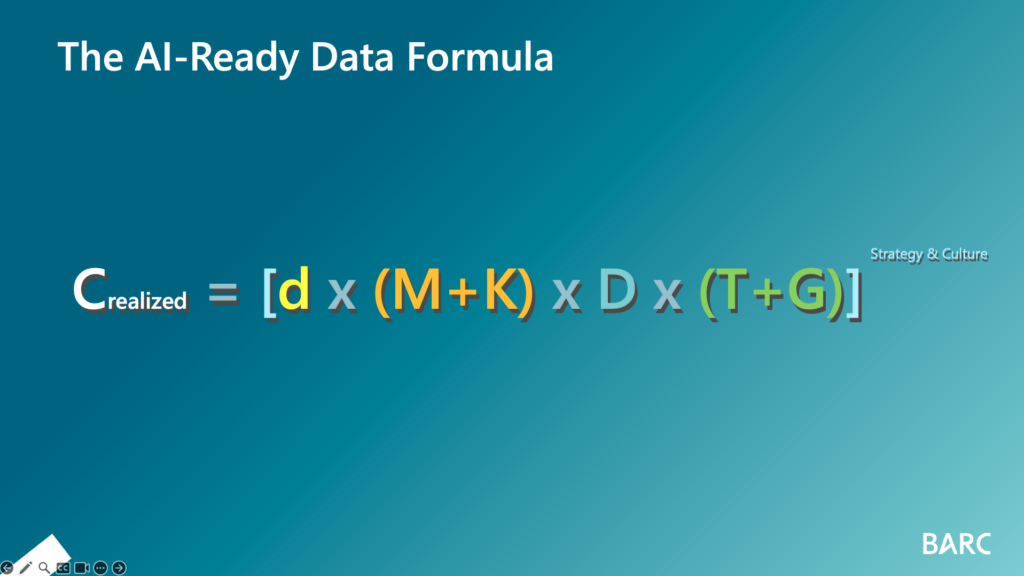
Let us unpack the five factors one by one.
What does Democratization (d) mean for AI-Ready Data?
This is not about “open access” and definitely not about “anyone can query anything”.
It is about speed and reliability when
- finding the right data and the right knowledge
- understanding what it means
- evaluating whether it is fit for purpose
- accessing it fast enough to be operationally useful
Democratization is a multiplier because speed of retrieval is part of correctness. If people cannot reliably find and interpret the right context, they will use whatever is in reach. AI does the same, only faster.
Failure mode: “We have it somewhere.” That sentence is the sound of d trending toward zero.
Why are metadata and a glossary (M+K) not enough?
Here is the core misconception: teams equate “knowledge” with “a glossary”.
A glossary is a starting point, sometimes a necessary one. It is not the room.
Metadata is the space where data and artifacts become human- and machine-readable. That includes
- technical metadata (schemas, pipelines, lineage)
- operational metadata (usage, quality signals, freshness)
- social metadata (ratings, comments, behavior, decisions)
- governance metadata (ownership, policies, classifications, allowed purposes)
- and semantic models
The depth of metadata and knowledge ranges from flat taxonomies (glossaries) all the way to formal ontologies. Which depth pays off depends on the use case and on the level of agent accuracy and transparency you actually need. “Glossary only” is not automatically sufficient. “Ontology everywhere” is not automatically the right answer. For the formula, the point is simple: (M+K) must not be zero.
If meaning is missing, AI cannot “infer” it. AI invents it.
Failure mode: “The model will figure it out.” No, the model will guess. And then your organization will operationalize the guess.
What role does Data (D) play in the bigger picture?
Obvious, but worth saying: AI-Ready Data is not just tables.
It includes
- structured data (warehouse, lakehouse, operational stores)
- unstructured data (documents, tickets, policies, contracts)
- the glue artifacts (dashboards, metric definitions, semantic layers)
The trap is believing that D alone gets you there.
More data without (M+K) just means bigger ambiguity. More data without (T+G) just means bigger risk.
Failure mode: “Let us ingest everything.” That is not a strategy. That is an uncontrolled expansion of liability.
How do Trust and Governance (T+G) secure AI-Ready Data?
This is where most AI initiatives quietly die. Not because governance blocks value, but because value without controls turns into an incident.
Trust here is not a vibe. Trust is a quality stack made of
- data quality
- model quality
- application quality
Governance is the enforcement mechanism. Not a slide. Not a policy PDF. Controls that actually run.
Think in control families:
- Lineage and provenance controls: where did it come from, how did it change, versioning, audit trails
- Access and policy controls: roles and rights, purpose-based access, masking and redaction, secrecy levels, license and usage rules
- Governance controls: clear owners and stewards, approvals, standards, data contracts and SLAs, compliance checks
- RAG and agent controls: allowed sources, guardrails, attribution rules, grounding checks, drift and bias monitoring, prompt and tool permissions
- Operational controls: monitoring, alerts, incident handling, change management
- Sovereignty controls: where data and models run, what crosses borders, who holds the keys
Quality describes how good your context is. Controls keep it good, keep it legal, keep it safely under your control, and keep it aligned with intent.
Failure mode: “We will add governance later.” Later is after the first leak, the first wrong decision, or the first regulatory question.
Why are Strategy and Culture (S+C) the uncomfortable exponent?
The exponent exposes whether the organization is serious.
You can have data, metadata, and governance and still fail if
- AI is not aligned to strategy
- use cases are not chosen and prioritized
- the economics are not understood
- AI literacy is missing at leadership and operator level
- the operating model is unclear (who owns what, who approves what, who is accountable)
- communication is weak and adoption turns into shadow usage
Strategy and culture do not “support” AI-Ready Data. They determine whether it becomes operational reality.
Failure mode: “We bought the platform.” A hammer does not build a house.
Whoever controls the context controls the AI
The reason “context” matters so much is not philosophical. It is economic and political inside your architecture. Whoever controls the context controls the AI. Whoever controls the AI controls the decisions. Whoever controls the decisions controls the business outcomes and charges rent for access.
That is why the context wars have started. Vendors are building tollbooths around meaning, not just around storage. End customers should demand context authority and sovereignty, not just “AI features”. Do not underestimate this topic.
What you should do next
If you want to build AI-Ready Data in your own organization, start here:
- Score every planned AI use case against all five factors on a scale of 0 to 1
- Identify the weakest factor, because it caps the overall result
- Invest there first, before acquiring more data or more models
- Anchor controls before you roll out
If you want to structure this assessment together with analysts and practitioners, talk to the BARC team. We have guided organizations on data and AI strategy, architecture, and governance for more than 25 years.
Your next step: Book an AI-Ready Data Assessment with BARC and find the weakest factor in your formula before it slows down your next AI project.