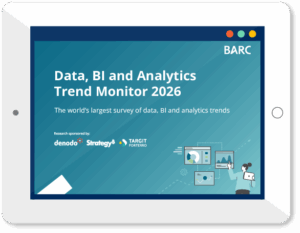
The market’s priorities are clear. They just don’t match the headlines. In the BARC BI & Analytics Survey 26 (n=857), 66% of respondents rate data security and privacy as very important, and 62% say the same about data quality management. By comparison, agentic AI ranks at just 17%.
Align your budget with the headlines, and you invest against your own needs. Self-service, generative AI (GenAI), and AI agents create value only when data quality, governance, and culture support them. Without that foundation, the next tool mainly scales the problems you already have.
This article puts the numbers in context and gives you, as a CDO, a way to assess where you stand: four foundational layers and a diagnostic grid. Before your next tool decision, you can see whether your data foundation holds up.
What the numbers say about the real priorities
Four of the five most important topics in the survey focus on the foundation, not the application. Data security and privacy lead at 66%, followed by data quality management at 62%, a data-driven culture at 51%, and data and AI governance at 44%. Agentic AI, the topic that dominates the headlines, lands at 17%.
The gap is the real signal. Data quality management and agentic AI are 45 percentage points apart. Practitioners who work with data every day know what actually derails their projects. They prioritize the foundation, not the symptom.
An AI agent running on bad data just reaches the wrong decision faster.
Why tools lose value without a foundation
Self-service puts data access directly into the hands of business users. When data quality is poor, self-service also spreads inaccurate figures and conflicting metrics. What should be a source of trust turns into a source of debate.
GenAI and AI agents amplify the problem. They produce convincing answers even when the underlying data is unreliable. Without governance, organizations lack clear controls over which data a model can access and who is accountable for its outputs.
Culture determines whether people actually use a tool. A tool that business users don’t trust sits idle, no matter how technically mature it is. That is why 51% of respondents rate a data-driven culture as very important.
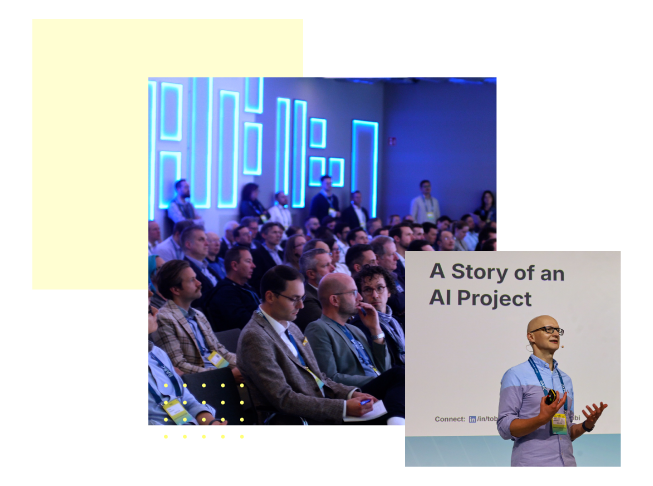
At the BARC Data & AI Summit 2026, we’ll show you how to use KPIs and ROI frameworks to quantify the business value of data and AI. Join us on November 11 and 12, 2026, at the VCC Würzburg. Secure your ticket now!
The four layers of the foundation
Data security and privacy (66%): Define access rights and data protection before an AI agent accesses production data. Specify which data a model can access and which data must never leave your systems.
Data quality management (62%): Measure completeness, timeliness, and accuracy using defined metrics. Assign an accountable owner to each data domain instead of relying on a one-time cleanup before the project starts.
Data-driven culture (51%): Ensure business users base decisions on data. Culture grows through training, leadership that sets the example, and data literacy across the organization.
Data and AI governance (44%): Define roles, approval processes, and traceability. Governance specifies who can use which data, who approves models, and how model use is documented.
Does your data foundation hold up?
Review the five checkpoints below. Each warning sign points to an area that needs attention.
Checkpoint
The question you need to answer
Warning sign
Data security and privacy
Have we defined which data an AI model can access and which data may leave our systems?
“We’ll sort out access rights once the use case is set.”
Data quality
Do we measure data quality using defined metrics and accountable owners?
“We clean data project by project.”
Culture
Do business users base their decisions on data?
“The numbers make it into the report, but the decision is still based on gut instinct.”
Governance
Is it documented who approves the use of data and models, and who is accountable for them?
“IT is in charge, but no one is accountable.”
AI readiness
Is the foundation in place before we put AI agents into production?
“We start with agentic AI and solve governance later.”
What to do next
Allocate your investment budget to the four foundational layers before you evaluate the next tool.
Define measurable metrics for data quality and assign an accountable owner for each data domain.
Define which data an AI model can access and which data may leave your systems before putting the first AI agent into production.
Build data literacy among business users so new tools actually get used.
AI is live. But is it paying off?
BARC Data & AI Summit | November 11–12, 2026 | Würzburg, Germany
More companies are putting AI into production, and budgets keep growing. But not every initiative delivers measurable business value.
At the BARC Data & AI Summit, we look at what actually works and what’s just a good story.
As Head of Data, AI & Analytics Strategy & Culture at BARC, Tobias Riedner helps organizations turn data and AI into real business impact. He combines strategy, operating model design, governance, architecture, and leadership enablement to help companies build scalable, business-driven data and AI capabilities.
He has extensive leadership experience in international corporate environments where he has led major transformation initiatives involving data platforms, CRM, governance, and AI-enabled decision-making. With his strong entrepreneurial mindset and practical understanding of what it takes to drive adoption, Tobias helps organizations translate ambition into clear priorities, aligned teams, and measurable outcomes.
His current research and consulting activities focus on data and AI strategy, organizational transformation, decision intelligence, and the human side of becoming a data-driven business.
DATA festival Online. Experience Data & AI with the community shaping what’s next.