



New BARC research highlights rising cost pressure, data quality failures and a persistent maturity gap in AI delivery
BARC has released a new research study, Lessons from the Leading Edge: Successful Delivery of AI/GenAI, based on responses from 421 organizations worldwide. The study provides a detailed picture of how companies are delivering AI and GenAI projects in production today, and why only a small group consistently succeeds.
The research shows that organizations with strong AI leadership practices deliver significantly more. These mature companies run a far higher number of production AI projects and demonstrate greater consistency in execution. But despite the surge in AI adoption, the share of companies that meet BARC’s criteria for AI leadership remains limited. This maturity gap continues to shape the industry’s ability to scale AI effectively.
“We now have a clear view of what separates successful AI adopters,” said Shawn Rogers, CEO BARC US. “Leaders invest early in governance, data readiness and architectural clarity. Many others move straight into implementation and feel the consequences later in the form of rising costs, data roadblocks and stalled initiatives.”
Data Quality and Cost Pressures Challenge AI Scalability
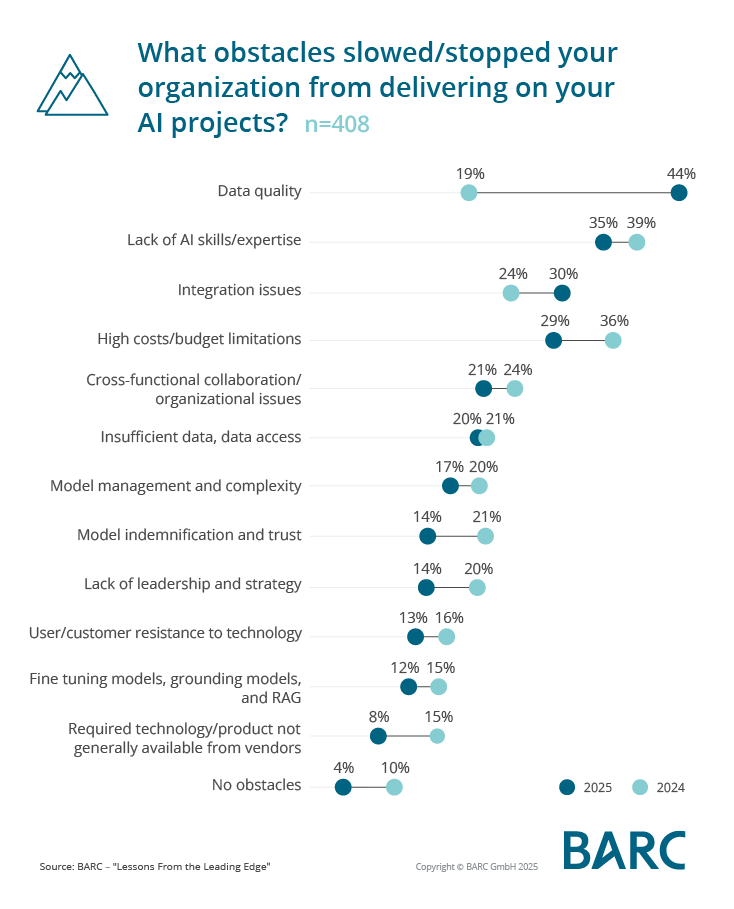
One of the clearest warning signs in this year’s results is the rise of data quality as the number one barrier to AI success. In BARC’s 2024 research, data quality was a secondary concern. In 2025, it became the top obstacle for 44 percent of organizations, surpassing skills shortages, integration issues, and budget constraints.
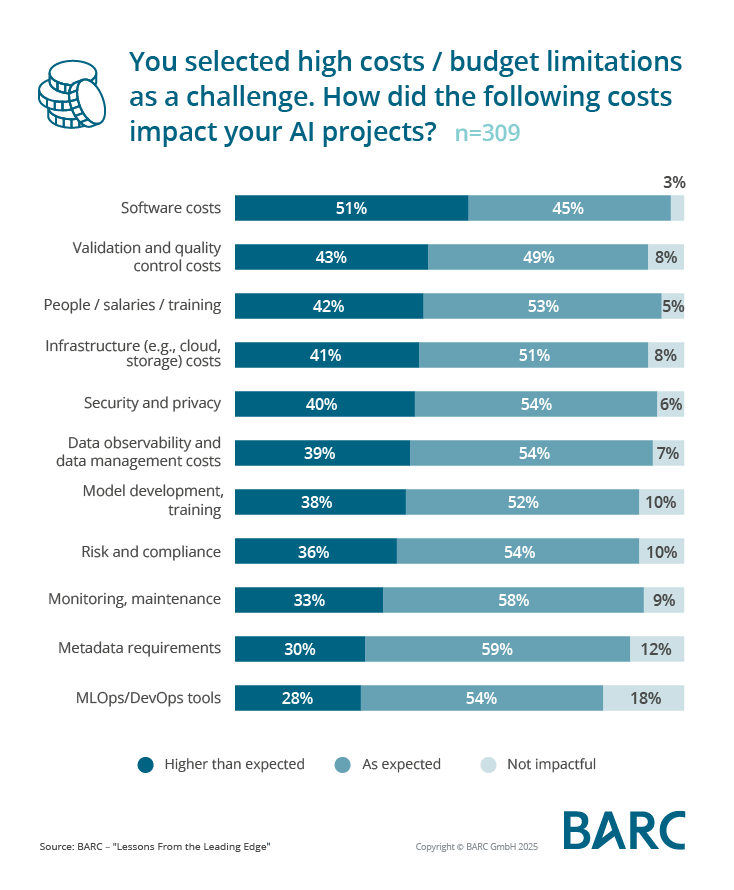
Cost pressure is another critical theme. Software expenses exceeded expectations for more than half of respondents, with validation, quality control and training costs close behind. This shift has pushed organizations toward more cautious project scopes and phased delivery models.
Internal IT Dominates Delivery but Shows Lowest Satisfaction
A further finding concerns delivery partners. Internal IT remains the default driver of AI projects, but it also earns the lowest satisfaction scores among respondents. In contrast, regional and global consulting firms receive the highest ratings for project success and delivery effectiveness.
“The maturity gap is not closing,” explained Merv Adrian, BARC Fellow. “Companies feel pressure to move fast, but scaling AI without a solid foundation is proving difficult. The data shows that organizations which learn from their early efforts, adjust course and build the right structures are the ones that achieve repeatable success.”
The study also highlights rapid adoption of agentic AI, growing use of domain-specific models, and shifting priorities in responsible AI, with privacy and compliance rising as top concerns.
Lessons from the Leading Edge: Successful Delivery of AI/GenAI is available for download free of charge thanks to the support of BigEye, InterSystems and Board.