Data leaders balance two speeds: governance for stability, innovation for AI impact. Discover why doing both separates leaders from laggards in BARC's 2026 data.
One of the clearest stories in our 2026 Trend Monitor is the difference between leaders and laggards. Leaders look very consistent. They take data quality, security, culture and governance seriously. At the same time they are already working on decision intelligence, embedded analytics, generative AI and topics like data valuation and monetization. They do both.
Laggards do not. They stay in operations and compliance. They keep the lights on, but they do not create new value from data. The gap is not only technical. It is a management gap. The leaders have learned to run two speeds at once.
What do we mean by the two speeds of data leadership?
Speed 1 is the stability speed. This is where data quality management lives. This is where data security and privacy live. This is where data governance lives. This is where you define roles, ownership, access and protection. This speed is not fast, because it has to be correct. It is the part that keeps the company safe and keeps analytics trustworthy.
Speed 2 is the innovation speed. This is where decision intelligence and automation come in. This is where embedded analytics and AI make processes smarter. This is where generative AI pilots run. This is where data products are tested and delivered. This speed is fast, because the business wants to see impact.
Many organizations still try to manage governance and innovation as opposing forces. This rarely works. What is actually needed is not a separation, but a continuous balancing act. Leaders succeed because they deliberately avoid playing governance and innovation against each other. Instead, they empower business domains to drive innovation themselves while actively supporting them with clear, federated governance principles.
What does the BARC Trend Monitor reveal about successful data leaders?
In the data we see that leaders rate the foundational topics just as high as everyone else. They do not skip hygiene. The difference is that they also rate innovation topics higher than average.
However, their leadership is not based on blindly chasing trends. It is based on a deep understanding of what these trends really mean for their business and how to use them in a focused way to create measurable impact. This impact shows up in the P&L, not just in polished slide decks.
We also observe different perspectives across the ecosystem. Operational teams tend to focus on reliability and sustainability, while software vendors often emphasize new capabilities and innovation potential. Organizations that are successful do not choose one of these views. When planning their data strategy, they combine operational sustainability with the courage to innovate – from a process and project perspective, as well as when selecting new tools for their technology landscape.
How can organizations structure governance and innovation effectively?
An effective model focuses on four principles.
Bring the right stakeholders together: Define data, analytics and AI priorities collaboratively across IT, data teams and business leaders to maximize the data & AI impact on the P&L sheet.
Move responsibility into the business domains: The most impactful data and AI use cases are created where business problems are deeply understood. Leaders therefore anchor responsibility for activating data directly in the domains and support them with federated standards instead of central control.
Communicate to create understanding, not compliance: Make transparent which governance principles exist, which risks they mitigate and how teams can still innovate within these boundaries. Our experience shows: There’s always a way to communicate more effectively and almost certainly it will pay off.
Create a culture of data quality: People who create data must understand what happens downstream. When employees see how their inputs affect decisions, customers and processes, data quality stops being a rule and becomes a mindset.
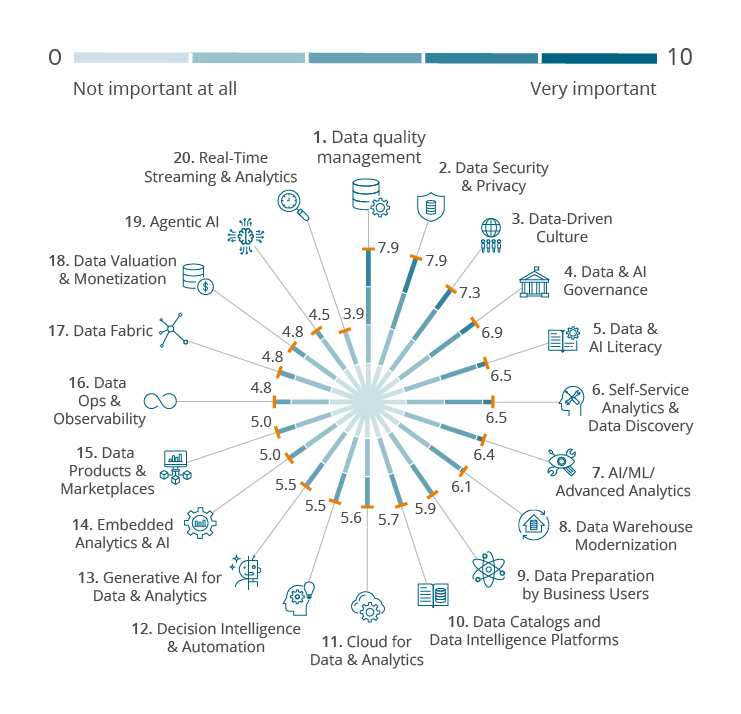
How important are the trends in data, BI and analytics?
Figure 1: How important are the trends in data, BI and analytics? Soruce: BARC Data, BI & Analytics Trend Monitor 2026; n=1,579
Why should executives care about balancing stability and innovation?
Executives often see only the innovation speed. They want visible AI. They want analytics in processes. They want to show progress to customers and to boards. That is legitimate. But if the stability speed is underfunded, the whole AI story becomes fragile. The Trend Monitor shows that the market has understood this. The top five trends are all stability topics. The growth topics sit below them.
A good executive message is therefore very simple. We invest in foundations to make AI safe. We invest in innovation to make AI useful. Both are needed.
What does the two-speed model mean for data professionals?
The two-speed model enables innovation precisely because it doesn’t sacrifice stability for speed. By establishing a solid data foundation organizations create a trusted environment where experimental AI projects and analytics can move quickly without introducing unacceptable risk. Investing in data quality, for instance, pays dividends twice: decisions are made on accurate information that reflects reality, and AI agents or chatbots understand your business context far more precisely, enabling them to take meaningful action based on data that truly represents their environment.
What is the key takeaway for scaling analytics and AI?
The 2026 results do not describe a market that is confused. They describe a market that is aiming to innovate responsibly. Leaders learn to innovate fast while understanding which foundations they need to deliver sustainably.
Companies that focus solely on the foundations will risk that they jeopardize their current business model; because they do not evolve their business model in times where analytics and AI changes their environment. Those that innovate without foundations will most likely expose themselves and many stakeholders to too much risk, including the risk of harming them with AI. Companies that tackle both will be the ones that will be able to scale AI.
Data, BI and Analytics Trend Monitor
The new Data, BI and Analytics Trend Monitor shows you which trends are shaping the BI, analytics and data management market. Find out now which trends are really worth investing in!
Florian is an Analyst for Data & Analytics with a focus on Data Management. His primary interests include topics such as Data Catalogs, Data Intelligence, Data Products, and Data Integration.
He supports companies in selecting suitable software solutions, analyzes market developments, addresses the needs of user organizations, and evaluates innovations from software vendors.
As a co-author of BARC Scores, Research Notes, and Surveys, he regularly shares his insights and expertise. He frequently moderates events on data management topics. He is particularly fascinated by the rapid pace of technological advancement and the central role of data management in enabling the success of forward-looking technologies such as artificial intelligence.
Our newsletter is your source for the latest developments in data, analytics, and AI!