




The value of planning software shows up in day-to-day work: Do forecasts come together faster, are assumptions more transparent, and are results more reliable? BARC’s study The Planning Survey 26 gives an early indication: 87% of specialized planning software users would probably or definitely recommend their solution to a similar company. Among companies that use Excel as their main planning tool, it’s 41%.
That’s a wide gap, and it tells you users rate specialized tools more favorably for planning. It won’t justify an investment on its own, though. Before you buy, you need to spell out what a new solution should improve in your own planning process.
That’s the business case’s job. It turns expected improvements, such as greater transparency, faster forecasts, better planning quality, and less manual work, into measurable targets, and it accounts for the full cost, the prerequisites for implementation, and the risks. One question has to be on the table, too: Which capabilities does the software deliver, and which does your organization have to build itself? The result is a clear, transparent basis for the investment decision and for measuring success later.
The biggest payoff isn’t short-term cost savings
The results of The Planning Survey 26 show a clear pattern. Specialized planning software delivers the most value in transparency and traceability, more precise and detailed planning, quality of planning results, and planning frequency. Cost reduction and headcount savings rank at the bottom of the Business Benefits Index (BBI).
This finding matters for your business case. Focus almost entirely on license fees, personnel costs, or short-term savings, and you’ll capture only part of the economic value a planning solution delivers. The bigger impact often comes when decision-makers can get current information faster, follow the assumptions behind the numbers, and reliably compare options.
The Excel comparison shows how wide the gap is. On the BBI scale, specialized planning software scores 8.4 for transparency and traceability, compared with 4.7 for Excel. For quality of planning results, it’s 7.7 versus 4.1. For planning frequency, it’s 7.5 versus 4.0. Those are clear differences in the planning benefits users achieve. The scores don’t prove causality, and you’ll still need a cost-benefit analysis for your own company. They do, however, offer solid guidance for selecting suitable benefit areas.
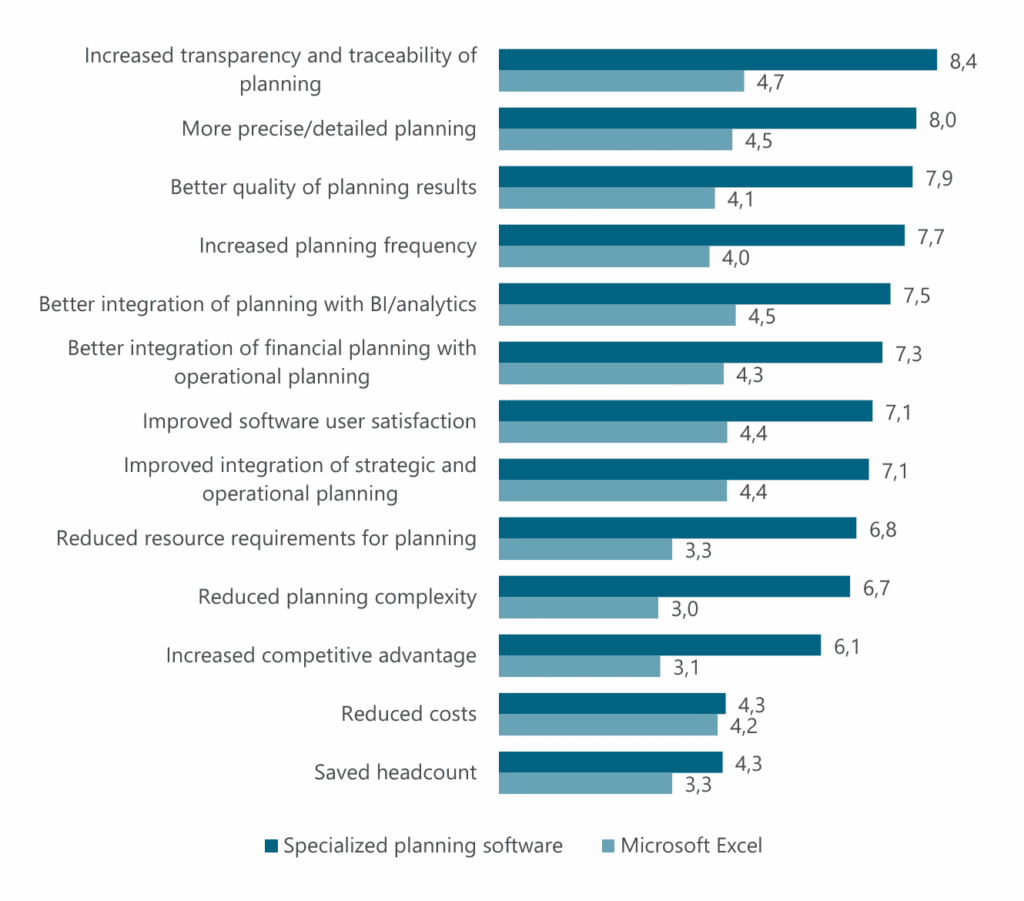
The study doesn’t attribute these differences to feature lists alone. Specialized planning software brings actuals, plans, and forecasts together in a central data model. This allows shared plan versions and well-defined workflows to improve transparency, quality, and planning frequency. The almost identical BBI scores for cost reduction are an important reality check. Justifying the investment almost entirely with short-term savings means applying the wrong standard. Your business case should show instead how the new architecture supports faster management decisions that rest on firmer ground.
Five benefit areas at the core of your business case
A convincing business case combines financial and operational benefits. A structure built around five benefit areas works well for this.
1. Less effort in the planning process
This area covers improvements that reduce the effort required for recurring planning tasks, such as automated data loads, fewer manual reconciliations, central management of assumptions and versions, and faster consolidation.
Metrics you can track include:
- Hours spent collecting, cleansing, and consolidating data
- Length of a budget or forecast cycle
- Number of manual handoffs between systems and files
- Number of required correction and reconciliation rounds
- Effort required to produce standard reports and analyses
When you assess this area, separate time saved from the economic value you can actually capture. Freed-up capacity pays off when planners can put it toward analysis, scenarios, advising management, or other higher-value work.
2. Quality, transparency, and decision speed
Many of the most important benefits can’t be booked directly as a line item, but they shape how well the business is managed. An integrated planning solution can make assumptions, ownership, and changes easy to follow. It can connect actuals, plans, and forecasts consistently and show the impact of new assumptions faster.
Useful KPIs include:
- Time from a business event to an updated forecast
- Share of planning steps with documented assumptions and owners
- Number of data or version conflicts and the time it takes to resolve them
- Time to build and evaluate a scenario
- Share of management decisions based on a current forecast
These metrics make qualitative benefits verifiable. They show whether your organization gets to reliable answers faster and whether decision papers for management become more consistent.
3. Integration and scalability
Planning processes typically grow and mature over years. More legal entities, departments, data sources, users, and scenarios, plus greater granularity, all add complexity. Your business case should assess how much extra effort your current architecture will create as you grow and what economies of scale a new solution makes possible.
Factors to consider include:
- Number of integrated operational and financial sub-plans
- Effort to connect and maintain data sources
- Number of users, entities, and planning units
- Performance as data volumes and granularity increase
- Time to onboard a new planning use case
- How tightly strategic, financial, and operational planning are integrated
The value here comes from a platform that can absorb new requirements without rebuilding processes, interfaces, and models from scratch every time.
4. Risk and governance
Manual transfers, local files, and unclear versions create risks that traditional cost-benefit analyses often miss. Think incorrect plan figures, delayed decisions, dependence on individual employees, and approvals that lack a clear audit trail.
You can assess these risks based on specific events and effort:
- How often errors occur and how much effort it takes to fix them
- Number of critical files or models without a clear owner
- Effort for approvals, documentation, and reviews
- Key-person risk when knowledge sits with individual employees
- Cost and consequences of delayed or incorrect management decisions
Keep the assessment conservative. A risk scenario with clearly explained weighting is more convincing than a large loss estimate you can barely support.
5. Strategic agility
Modern planning software often supports additional use cases, such as rolling forecasts, simulations, scenario analysis, and AI-assisted forecasting. These capabilities belong in the business case only if your processes, data, and accountabilities actually let you use them.
The value might show up as evaluating more scenarios in less time, systematically factoring in external drivers, or tying strategic and operational planning more closely together. Benefits like these make a company more responsive in volatile markets. They also need specific targets, an accountable business unit, and a realistic rollout plan.
When it comes to scenario planning and AI, a product feature isn’t a realized benefit. Meaningful simulations require integrated sub-plans and a reliable driver model. AI-assisted forecasts need dependable, historically consistent data, clear ownership, and methodological know-how on the finance team. Your business case should treat these prerequisites as separate work packages, costs, and risks. The sequence: stabilize the data and integration foundation, build the driver logic and processes, then automate.
From expected benefits to a defensible calculation
For each benefit area, follow the same logic:
- Establish the baseline: How long does the process take today, how much effort does it require, and where do errors or delays occur?
- Set a target: What measurable improvement should the new solution deliver, and by when?
- Describe cause and effect: Which feature, process change, or organizational measure drives the improvement?
- Quantify the benefit: How much time, cost, or risk can you realistically reduce?
- Assign ownership: Who measures the impact and makes sure the planned change actually happens?
Build at least three scenarios: conservative, realistic, and ambitious. This shows which assumptions have the biggest effect on the outcome. Show particularly sensitive assumptions separately, such as actual adoption of the solution or the amount of working time saved.
Account for the full cost
A planning platform costs far more than its licenses. A complete business case includes all costs over the period you’re evaluating:
- Software licenses and usage-based fees
- Implementation and business design
- Data integration, migration, and model building
- Internal effort from finance, IT, and business units
- Testing, training, and change management
- Operations, support, and ongoing development
- Potential parallel costs during the transition
With these inputs, you can calculate total cost of ownership (TCO), annual net benefit, payback period, and return on investment (ROI). Make sure costs and benefits cover the same period and rest on the same assumptions.
Software selection has to put the business case to the test
Once it’s approved, your business case should become the evaluation framework for software selection. In The Planning Survey 26, 76% of respondents said they ran a formal competitive evaluation before buying. In the product-level results for Excel, that share is 13%, and 72% of Excel users use it without having formally evaluated it.
This goes beyond procurement. If requirements aren’t prioritized and tested under realistic conditions, problems with performance, usability, functional coverage, or data volumes only surface once the system is live. At that point, they delay the benefits and drive up total cost.
A sound selection process should:
- Derive and prioritize business, functional, technical, and economic requirements from the business case
- Compare multiple candidates against the same criteria and test scenarios
- Run a proof of concept (PoC) with your own data, your own use cases, realistic data volumes, and the people who will actually use the system
- Weight usability, performance, integration, and scalability more heavily than a long list of new features
- Check whether the planned benefit KPIs are actually measurable and achievable with each solution
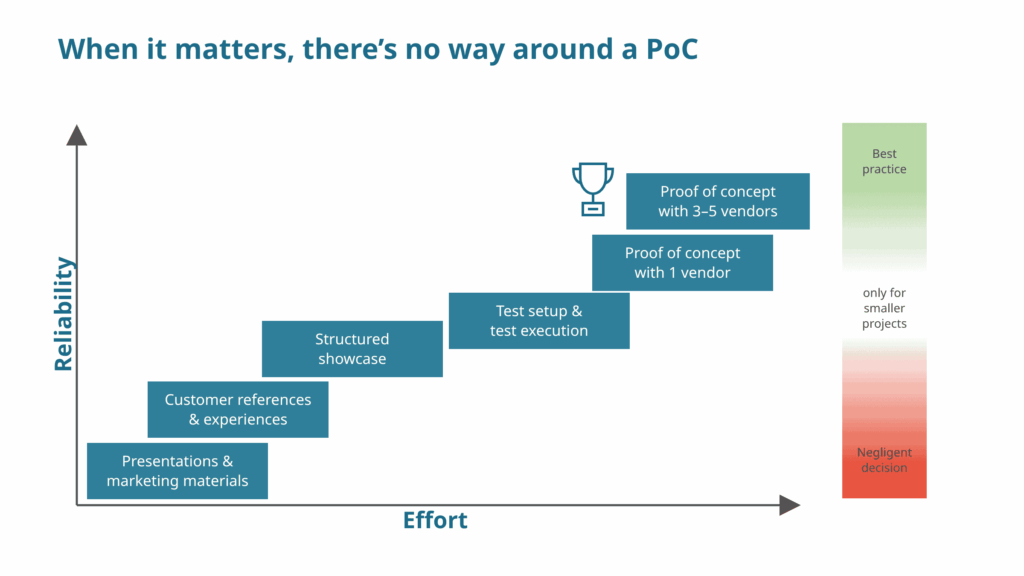
That way, the business case becomes more than a budget justification. It becomes the benchmark for software selection.
The business case doesn’t end with the investment decision
A good business case becomes the basis for steering the implementation. Build the KPIs you selected into your project goals and use them to measure success later. After go-live, check which benefits you actually achieved, where your assumptions were too optimistic, and which organizational hurdles are limiting the benefits.
The Planning Survey 26 shows that users of specialized planning software report greater transparency, better planning quality, and higher planning frequency more often than Excel users. That’s useful guidance, but it doesn’t guarantee success at any individual company. You still need to define the expected benefits clearly, assess them realistically, and measure them after implementation.
Built this way, the business case justifies the software budget and pins down which improvements the new planning solution should achieve. It also spells out what finance, IT, and management each need to contribute.
Want to turn your business case into a solid software selection? BARC supports you independently, from requirements analysis to proof of concept.