



In today’s business world, companies face a major transformation: moving away from limited, IT-oriented use of data toward data-driven business models, process improvement and automation through the use and analysis of data, and more fact-based decision-making.
This transformation is also cultural. To ensure data strategies succeed, organizations must foster a ‘data culture‘—an environment where data-driven goals can become a reality. But how can a company move from relying on instinct to becoming a data- and insight-driven enterprise?
This article presents the key points to establish a data culture in your company and become a truly data-driven, agile enterprise.
- Fundamentals: What is a data culture?
- Goals and effects of a data culture
- Why a data-driven culture is important – the advantages
- Challenges in building a data culture
- Achieving a successful data culture with the BARC Data & AI Culture Framework
Listen now! The Data Culture Podcast with Carsten Bange

Mit dem Laden des Videos akzeptieren Sie die Datenschutzerklärung von YouTube.
Mehr erfahren
Fundamentals: What is a data culture?
Data Culture Definition
Data culture is a component or manifestation of corporate culture. It refers to all shared values, social norms, and approaches that shape the behavior of members of the organization internally and in their external impact.
In a data-driven corporate culture, data is a vital resource that significantly influences actions and decisions at all levels of the organization, right up to the company’s business model.
While companies have always tracked their KPIs and individual data points, a data culture uses data more broadly, shaping how employees communicate and collaborate.
Goals and effects of a data culture
A data culture cannot be bought or imposed. It emerges from various factors such as organizational structure, rewarded or sanctioned behavior, and the communication and decision-making of managers . The development of a data culture can, however, be actively supported – particularly by addressing the methods systematized in the BARC Data & AI Culture Framework (see below).
The main goal is to enable all employees to use data actively. This not only makes their daily work easier but also allows the company’s full potential to be realized. Active use of data leads to better decisions, more effective initiatives, and clearer competitive advantages.
In addition to the strategic level of the business model and the operational level of process execution and improvement, there is a central leverage point for establishing a data culture that applies across all hierarchical levels of an organization: decision-making.
In companies with a data culture, decisions are made less on the basis of experience or gut feeling and more on data-based facts. whether simple KPIs such as revenue or profit, results from advanced analytics models, or qualitative information from the company or its environment.
From our point of view, The goal is not to make 100% of decisions data-based. But data should be placed at the center of decision-making in most cases.
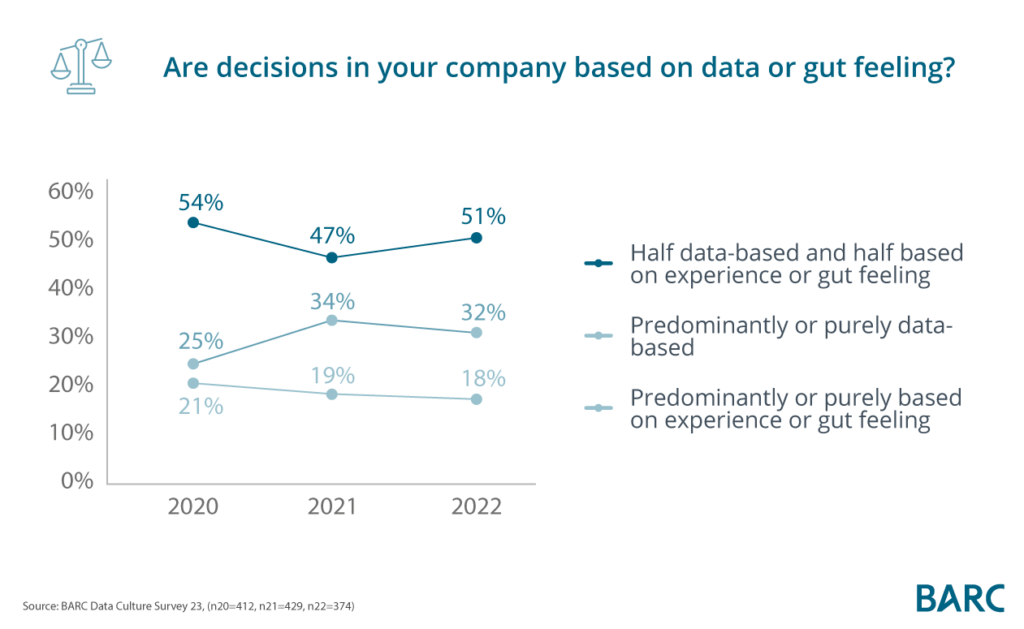
Companies are on the way to a data-driven decision-making culture. According to the BARC Data Culture Survey 23, one third of the 400 companies surveyed said they base their decisions on data. Just one year earlier, only one in four companies made decisions primarily on data (Fig. 1).
Effective data collaboration extends beyond typical data-oriented roles (like Data Owners, Stewards, and Scientists) to include every employee who uses data to do their job.
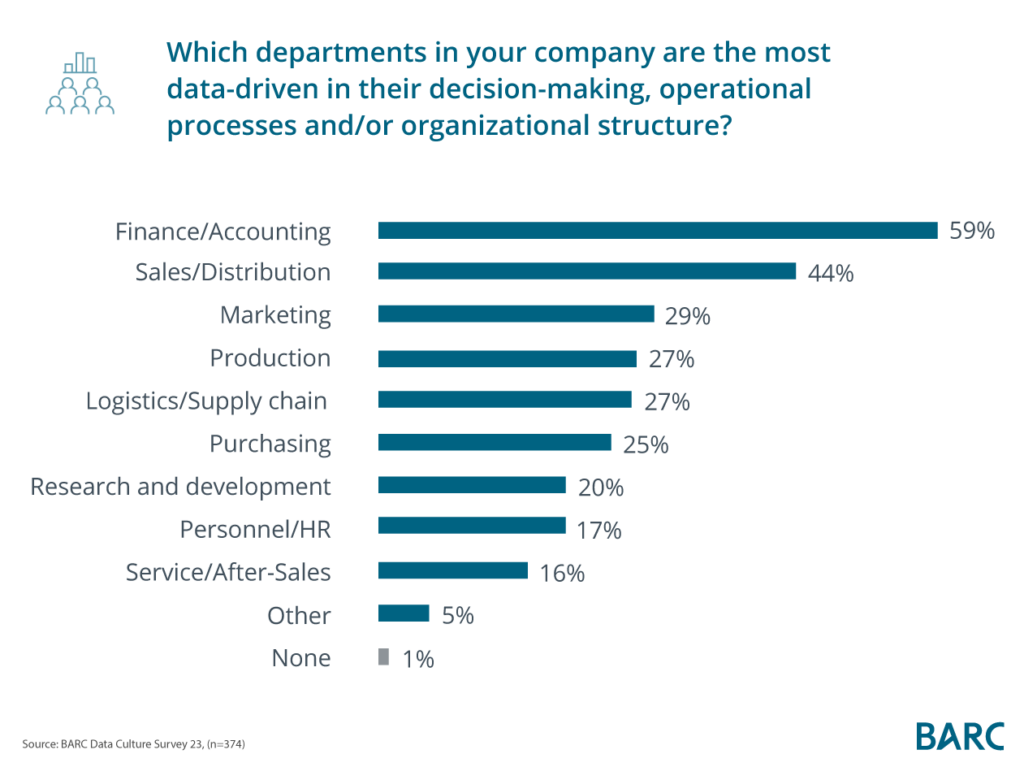
However, large differences remain between departments when it comes to data-driven decision-making, leaving room for improvement (Fig. 2).
Why a data-driven corporate culture is important
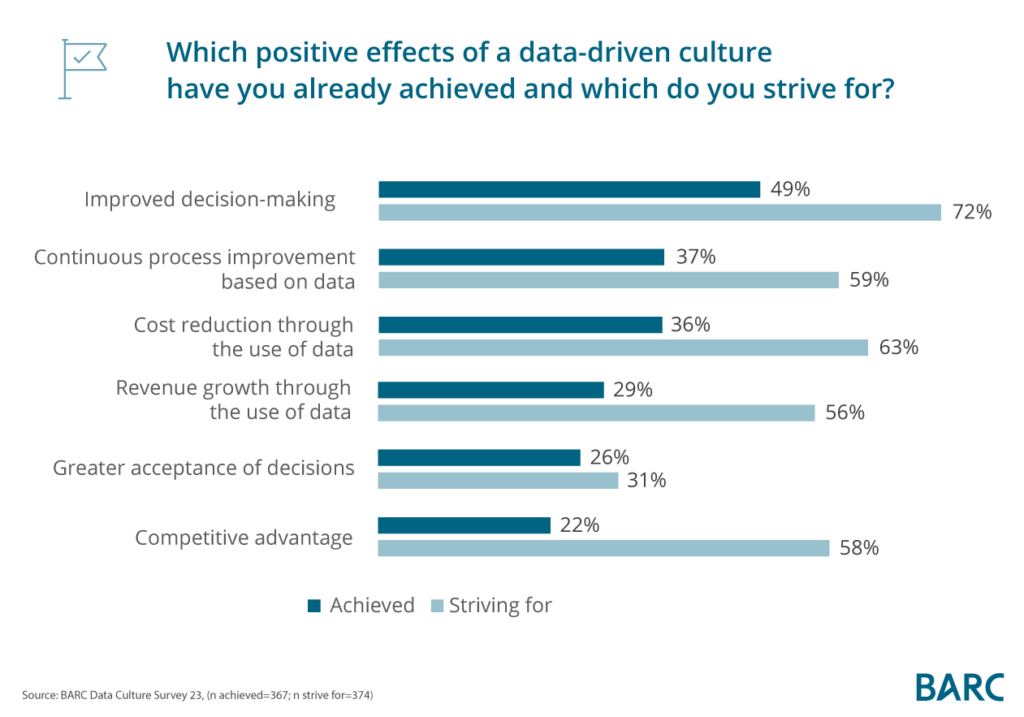
Improved decision-making, process optimization, and cost reduction are the most
tangible benefits of a data culture.
Before meaningful change can be achieved, it is important to know the benefits and results that can be obtained. Initiatives toward a data-driven culture are no exception
Respondents to the BARC Data Culture Survey 22 most frequently reported improving decision-making, reducing costs, and improving processes through the use of data. Other benefits achieved include increased revenue, greater acceptance of decisions, a shared understanding of data, and improved competitiveness.
Further benefits of a data culture
A data culture is an essential part of modern corporate culture in the 21st century. It creates an innovative workplace that attracts and retains top talents. Employees are often eager to apply newly acquired data skills to improve processes, make better-informed decisions, or create data products. The motto here – in a very real sense – is “use it or lose it.”
An understanding of processes and their success gained from data can also help adapt both processes and the associated organizational structures with agility.
Challenges in building a data culture
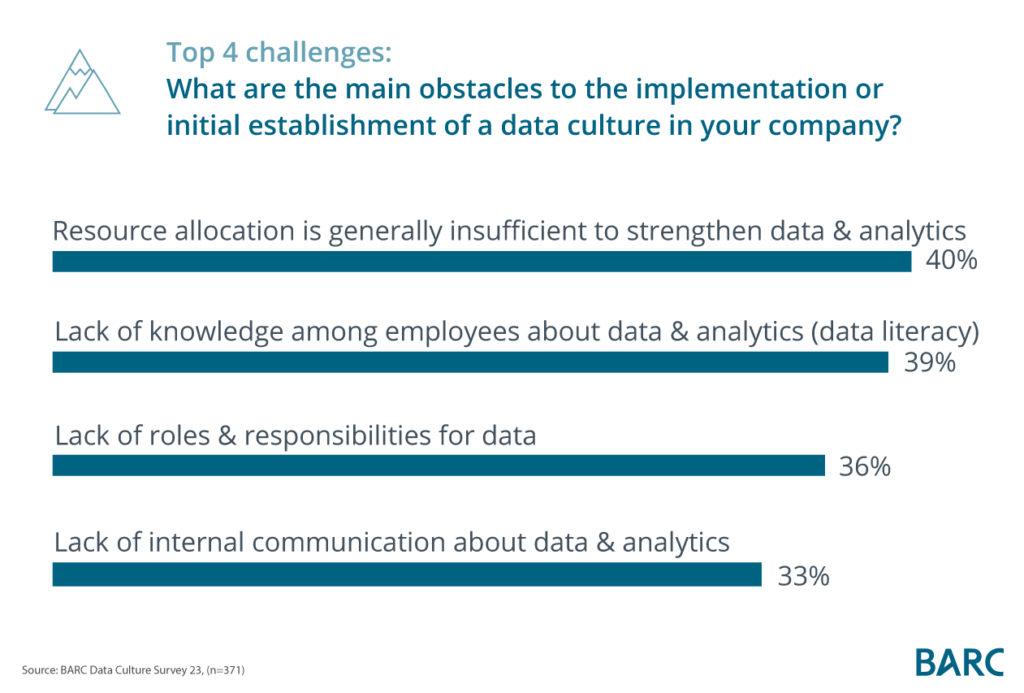
The five biggest stumbling blocks for data culture
Despite the clear benefits, becoming a data-driven company with a strong data culture is not easy.
Many organizations have already invested heavily in data management – for example, in data integration platforms, data warehouses, data lakes, data lakehouses, data fabrics, or other systems and approaches . Nevertheless, 87% of the 419 respondents to BARC’s “Leverage your Data” survey in 2020 said their business results could improve significantly if they optimized their handling of data.
Clearly, most are still far from being truly effective data-driven enterprises. So what prevents companies from developing a successful data culture? Here are five stumbling blocks that prevent organizations from unlocking the full potential of data:
1. Data is seen as the responsibility of IT
Business users see data as the domain of IT and of data scientists/analysts. And IT is reluctant to relinquish control. But a true data culture
must be embedded throughout the company and involve every employee.
2. Data is treated as a by-product of business processes
Data must be regarded as an asset – not just as a by-product (or waste product) of business processes. This means systematically collecting, organizing, sharing, and analyzing it.
A strong data culture creates the conditions for employees to find insights, connect those insights to business problems, and translate them into action. This approach creates tangible value and delivers a clear return on investment. This creates tangible value for the company and a return on investment in data & analytics in general and in data culture in particular.
3. Data are stored in silos
A common problem is that data exists in the company but remains inaccessible to employees. Beyond technical barriers, the primary obstacles are organizational: Data remains locked in silos due to restrictive access and a lack of accountability for sharing it.
A data-driven business removes silos and democratizes access to data. Every member of the organization must know where to find data and be able to use them.
4. Data quality is inadequate
Data quality remains high on the list of problems for data users and requires special attention within data governance programs. The necessary measures are largely organizational – e.g., taking responsibility and providing the resources needed for continuous quality monitoring and improvement.
The value of providing and analyzing data depends heavily on the quality of those data. Poor quality undermines reliability and usability, creates additional work and inefficient processes, and can even harm competitiveness. Ultimately, every company must ask itself: on what (data) foundation should the data-driven enterprise be built?
5. Too much or too little security and compliance
Data security and data privacy are top priorities in data management. Companies must comply with laws such as the GDPR to avoid fines and reputational damage. At the same time they must establish their own data ethics framework to govern the use of data.
The challenge is to find a balance between restrictions and rules on the one hand and empowering and encouraging employees to use data as broadly and lawfully as possible on the other. Excessive data protection combined with a culture of fear around using data is counterproductive.
Toward a successful data culture with the BARC Data & AI Culture Framework
A practical framework for Action
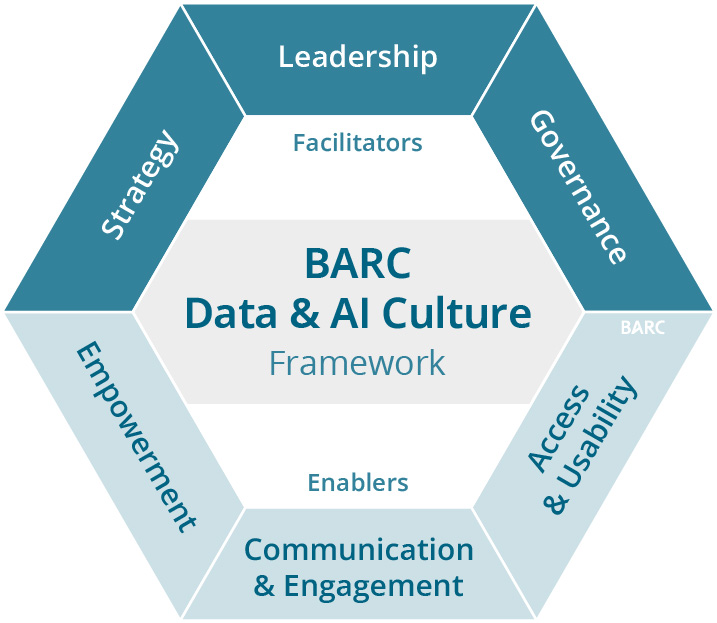
The BARC Data & AI Culture Framework was developed to help companies understand the key levers for establishing a data culture. The framework comprises six fields of action that can be addressed.
These fields have no set hierarchy, as their importance varies by company. However, data access and data governance are among the first topics most organizations tackle.
Facilitators: Must-haves for data-driven companies
The upper half of the framework – the so-called “facilitators” – describes must-haves for any company that wants to be data-driven.
The first one is Data Leadership. This covers the behavior of leaders, target-setting, organizational structure and process design, and establishing clear data accountability.
The second facilitator for establishing a Data Culture is a Data Strategy. A holistic data strategy takes into account business, organizational, and technical aspects, describes the desired target state, and the path to achieve it. Most importantly, it links the data strategy with corporate strategy making it clear to everyone how data initiatives contribute to overall business success.
The third facilitator is Data Governance. It combines the people, processes, and technologies required to manage and protect data assets in the company. The goal is to ensure corporate data are is understandable, accurate, complete, trustworthy, secure, and findable. This data quality forms the foundation for all further activities, ensures seamless business processes, and best supports decision-making.
Enablers: Embedding data culture among employees
The lower half of the BARC Data & AI Culture Framework addresses the “enablers”, which focus on employee involvement. As the primary carriers of corporate culture, employees are the ones who bring a data culture to life.
The first subfield is Data Access. This means, data must be made accessible and transparent. It also requires establishing clear organizational rules for access and ensuring employees have the necessary skills to use the information effectively (see Data Literacy below).
The data discovery process is particularly important. A new understanding of roles is needed. From now on, it is the responsibility of data creators to provide clear metadata (e.g. in a data catalog) so their data is understandable to everyone.
Data Communication is about more than setting implicit guidelines for requesting data. It must also be communicated how these data can be used. Structured and well-thought-out communication can significantly influence acceptance and adoption of the data strategy.
A first step is to explicitly inform employees about data projects, their goals, and their successes. The goal is to motivate employees to initiate their own data projects.
The final aspect is Data Literacy. The aim of data literacy is to enable individuals and organizations to identify, evaluate, prepare, analyze, and visualize data, as well as to master the necessary methods and tools. Data literacy also enables communication based on these data and the interpretation of analysis results.
Still want to learn more about data culture?
Listen to the “Data Culture Podcast” by BARC CEO Carsten Bange now!
Mit dem Laden des Videos akzeptieren Sie die Datenschutzerklärung von YouTube.
Mehr erfahren