


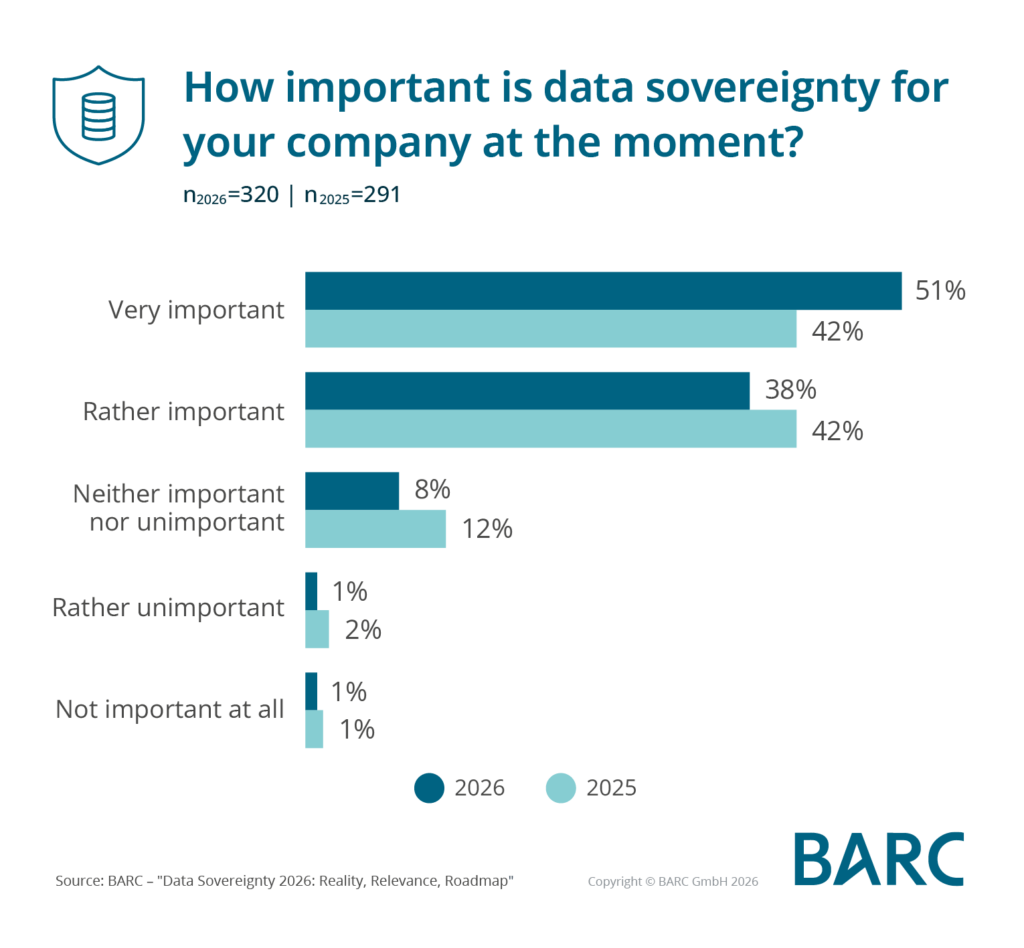
Data sovereignty has evolved from a compliance topic into a strategic prerequisite for data- and AI-driven core processes. This is the central finding of the global BARC study Data Sovereignty 2026: Reality, Relevance, Roadmap, for which 320 companies were surveyed. Accordingly, 51 percent of respondents rate the topic as very important (2025: 42 percent), and 76 percent expect its importance to keep rising. At the same time, 40 percent are not yet investing in related initiatives, and only 10 percent have a dedicated budget.
Drivers: from regulation to risk
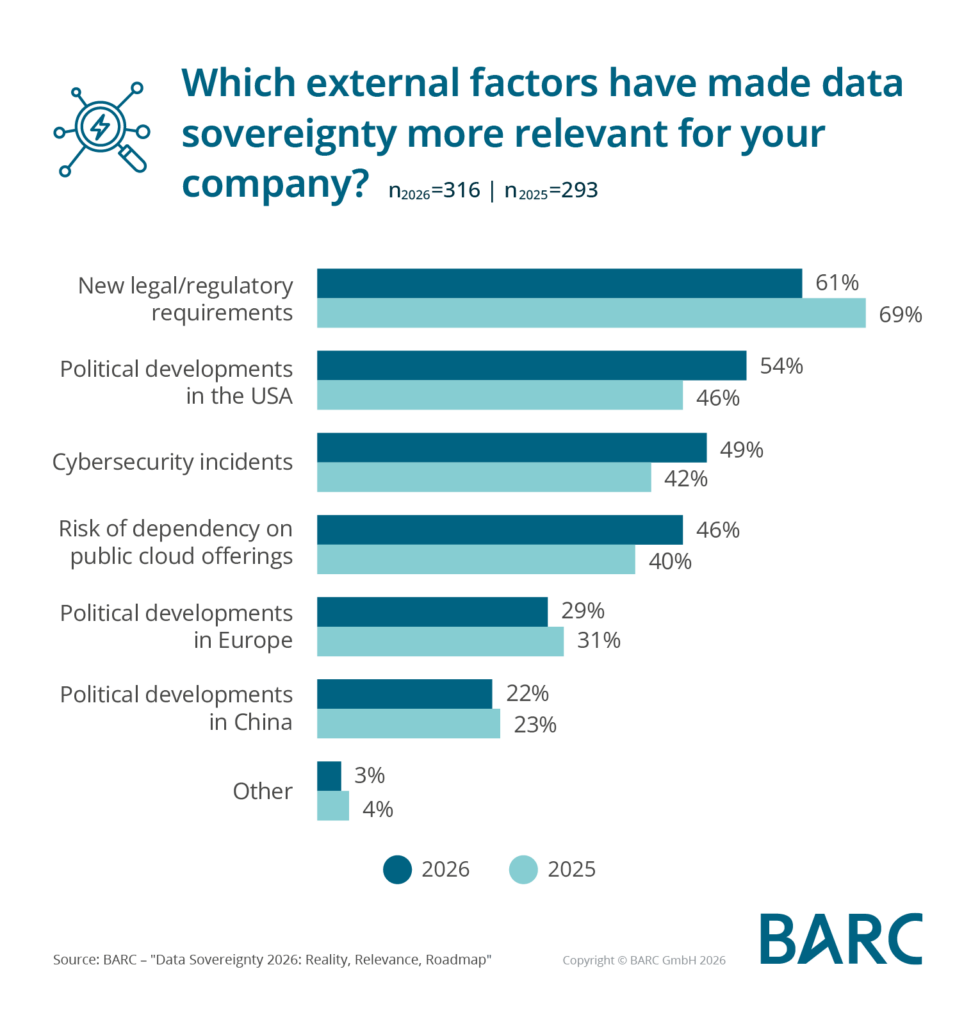
Legal requirements remain the most important external driver at 61 percent, although their dominance is declining (2025: 69 percent). Risk-driven factors are gaining ground: political developments in the US (54 percent, plus 8 points), cybersecurity incidents (49 percent, plus 7 points), and concerns about dependencies on public cloud providers (46 percent, plus 6 points). Internally, the use of data and AI in core processes (62 percent), growing data sensitivity (52 percent), and rising vendor dependencies (49 percent) are the leading factors.
Maturity and measures: security first, cloud strategy in transition
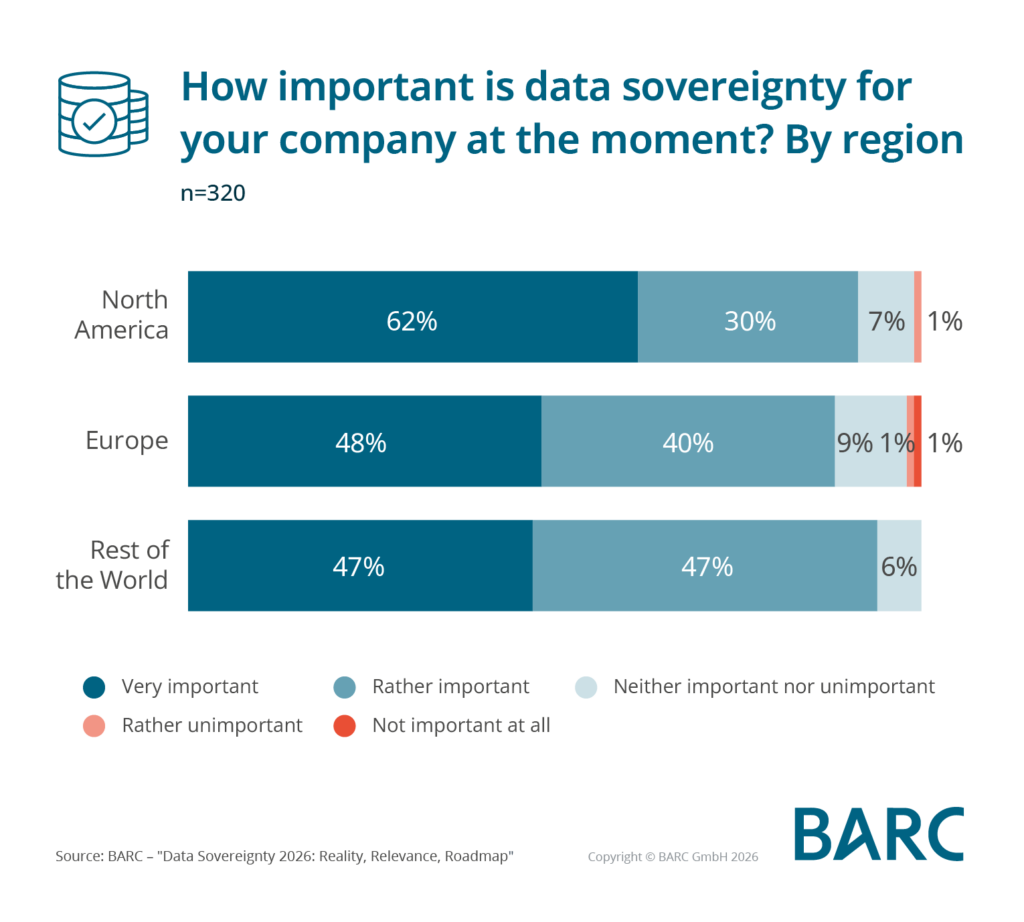
Only 38 percent of companies have an applied sovereignty governance, and 46 percent have an established technical architecture. On the action side, cybersecurity (43 percent) as well as hybrid cloud and on-premises strategies (35 percent) dominate. The share of companies with repatriation initiatives has doubled within a year, from 8 to 16 percent. North America stands out regionally: 73 percent of companies there fund sovereignty measures, compared to 56 percent in Europe.
Dr. Carsten Bange, founder and CEO of BARC, comments: “Sovereignty in 2026 has moved beyond a compliance add-on and has become a prerequisite for safely scaling data and AI in productive core processes. Many programs start with strategy and funding, then stall due to missing resources and technical hurdles. Organizations that want to scale need reproducible architectural patterns and clear governance guidelines.”
Sovereignty as a driver of innovation
46 percent of respondents see a positive effect of sovereignty initiatives on innovation capability, while only 9 percent see a negative effect. Among companies with a dedicated budget, the share of positive assessments rises to 71 percent. At the same time, technical hurdles have jumped sharply in 2026 (43 percent, 2025: 26 percent), and 44 percent cite a lack of personnel resources as a key obstacle.
Study access
The study is based on an online survey of 320 companies conducted in February and March 2026. The survey was sponsored by Actian, Exasol, OPITZ CONSULTING, Perforce Delphix, Schwarz Digits, and T-Systems and conducted in cooperation with Big Data & AI World Frankfurt.
The full study is available free of charge for download.