



A new global BARC study examines how organizations discover, govern, and operationalize unstructured data for AI, and reveals a sharp gap between confidence and reality.
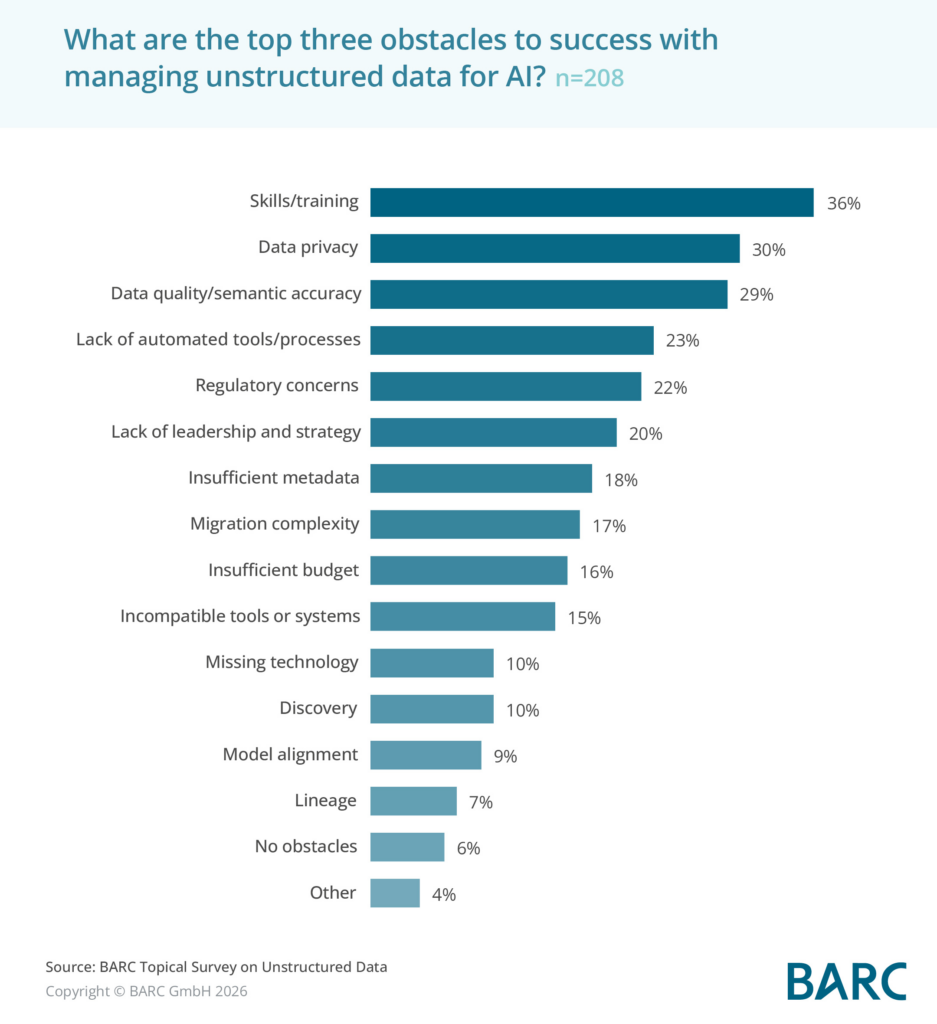
BARC has published the new global study Harnessing Unstructured Data for AI Innovation: Problems, Practices, and Principles for Success. Based on around 220 responses worldwide, it examines how far organizations have come in discovering, governing, and operationalizing the unstructured data that gives AI models and agents their context.
The study finds a sharp gap between confidence and reality. Only 29 percent of respondents fully know where their AI-relevant unstructured data resides, and 70 percent say less than half is discoverable and usable for analytics or AI. At the same time, 79 percent are confident they can extract value from unstructured data without breaking governance controls, even though roughly one third report deficiencies in data bias and lineage and 35 percent cannot trace how unstructured data is used across systems.
“Unstructured data carries the context AI agents need to act reliably, yet most organizations cannot say where it sits or how it is used. Scaling AI in 2026 will not work without a platform-independent semantic layer and a much sharper governance practice,” says Kevin Petrie, VP of Research at BARC US and lead author of the study.
Access the study
Harnessing Unstructured Data for AI Innovation: Problems, Practices, and Principles for Success is available for download at barc.com/research/harnessing-unstructured-data-for-ai-innovation. The study is available for free thanks to the support of Ohalo and Datahub.