




Anaplan Financial Consolidation and Reporting (FCR)
What is Anaplan Financial Consolidation and Reporting (FCR)?
Cloud-based enterprise platform that connects strategic, financial, and operational planning. It can be used across various business functions and industries. The Integrated Financial Planning (IFP) application offers an out-of-the-box approach to integrated financial planning, and the Financial Consolidation application extends the platform to provide end-to-end solutions for connected finance, including close and consolidation.
About Anaplan Financial Consolidation and Reporting (FCR)
The information in this section has been provided by the vendor of Anaplan Financial Consolidation and Reporting (FCR).
Self-description of the vendor
Would you like to find out more about BARC reviews? Our FAQs answer the most important questions.
Anaplan Financial Consolidation and Reporting (FCR) BARC Review & Rating
This section contains our independent analyst views on Anaplan Financial Consolidation and Reporting (FCR).
Provider and product description
Anaplan is a cloud-native enterprise software company whose mission is to enable agile, connected decision-making through its AI-driven scenario planning and analysis platform. The company currently employs more than 2,000 people worldwide. Several major investors have funded Anaplan’s growth and global expansion. In 2022, Thoma Bravo, a leading software investment firm, acquired Anaplan for approximately $10.4 billion. In 2024, Anaplan acquired Fluence Technologies, a provider of financial close, consolidation, disclosure management, and reporting solutions.
Launched in 2008, the Anaplan platform is a modern generation of planning, forecasting, modeling, and performance management solutions built on state-of-the-art technology and software architecture. The fully cloud-based platform is available in public cloud (e.g., Amazon (AWS), Microsoft (Azure), Google (GCP)) and private cloud environments and is powered by Anaplan’s proprietary, in-memory calculation architecture. In 2017, Anaplan pioneered the concept of connected planning. Its low-code technology connects financial, strategic, and operational plans with data insights and people to align strategic objectives and resources for better decisions and faster results. With the addition of Fluence (now Anaplan Financial Consolidation), Anaplan has strategically expanded its portfolio to provide end-to-end solutions for a more connected finance function, including close and consolidation.
Anaplan targets business leaders, corporate finance, controllers, and operational business departments to connect planning processes on a single platform that supports multiple use cases across finance, sales, supply chain, and workforce in large enterprises and corporations worldwide. Additionally, Anaplan and its partners offer prebuilt solutions and connected applications spanning these areas and specific industries. These applications are based on best practices and common customer use cases. They are built and run on the Anaplan platform and can be customized to meet specific needs.
According to Anaplan, it has more than 2,500 customers. Anaplan implementations include companies of all sizes, from SMBs to complex global businesses with several thousand users per installation. To sell and implement Anaplan, the vendor has a global ecosystem of over 250 partners for implementation, system integration, reselling, technology, strategy, and business consulting. This ecosystem is designed to enhance the platform’s capabilities and deliver tailored solutions across various industries.
Anaplan Financial Consolidation and Reporting (FCR) provides cloud-native (available in Microsoft Azure) support for statutory and management financial consolidation and close with additional capabilities for disclosure management, ad hoc analysis, and reporting. The application offers capabilities for administration of consolidation rules, methods, calculations, eliminations, and validations with auditable workflows. With Anaplan XL Reporting, users can report on Anaplan and non-Anaplan data sources via an Excel-based add-in and display this information in reports or dashboards. Reports can be viewed in Excel, on the web, or on mobile devices.
The Anaplan platform provides flexible functionality for top-down and bottom-up planning, including workflow support and collaboration capabilities. With its “connected scenario planning and analysis” platform, customers can create planning models at different levels of aggregation (strategic, financial, and operational) for an integrated enterprise planning approach. In 2024, Anaplan released its Integrated Financial Planning (IFP) application: a purpose-built, out-of-the-box solution that streamlines planning, budgeting, and forecasting processes. The vendor’s classic Hyperblock and new Polaris calculation engines support scalable, in-memory data processing for detailed planning models. As larger, more granular data sets are required for sound planning and informed decision-making, Anaplan is investing heavily in its new, more memory-efficient Polaris calculation engine, as well as its data management system and intelligence capabilities.
In 2024, Anaplan outlined a $500 million, multi-year product investment with a focus on enhanced platform capabilities, AI innovations, and additional applications, including a flagship Financial Planning and Consolidation solution (seamlessly combining IFP and FCR for the Office of the CFO). Delivering on this strategy, the expanded native platform enhancements and AI capabilities include Anaplan Data Orchestrator (ADO), Anaplan’s conversational AI assistant CoPlanner, and the vendor’s suite of role‑based AI agents. ADO improves data integration and connectivity with third-party applications and data sources, building the foundation for Anaplan’s AI strategy. It helps transform source data into the structure and format needed for Anaplan models. ADO also centrally stores transformed data to simplify monitoring, management, and distribution to planning models. The introduction of agents contributes to Anaplan’s ongoing stream of AI-driven innovations, including the Anaplan Forecaster, the Anaplan CoModeler agent, and four additional intelligent role-based agents (e.g., for finance), as well as the Anaplan Agent Studio, which supports customers in building their own custom AI agents.
Strengths and challenges of Anaplan Financial Consolidation and Reporting (FCR)
BARC’s viewpoint on the product’s strengths and challenges.
Strengths
- Anaplan is a modern, cloud-based enterprise platform that connects strategic, financial, and operational planning. It can be used across various business functions and industries. The Integrated Financial Planning (IFP) application offers an out-of-the-box approach to integrated financial planning, and the Financial Consolidation application extends the platform to provide end-to-end solutions for connected finance, including close and consolidation.
- Anaplan Financial Consolidation and Reporting (FCR) provides support for statutory and management financial consolidation and close with additional capabilities for disclosure management, ad hoc analysis, and reporting.
- Flexibility for a wide variety of planning approaches (top-down, bottom-up, mixed) and planning topics that support multiple use cases across finance, sales, supply chain, and workforce. Prebuilt solutions and connected applications are also available for selected use cases and industries that run on the Anaplan platform. These solutions can be customized to meet specific needs.
- Anaplan Intelligence provides context-aware AI for predictive analytics, ML, linear programming, and use-case-specific model building to deliver predictive and generative insights. Anaplan’s ongoing stream of AI-driven innovations includes the conversational AI assistant CoPlanner, the Anaplan CoModeler agent, role-based agents, Anaplan Forecaster, and Anaplan Agent Studio.
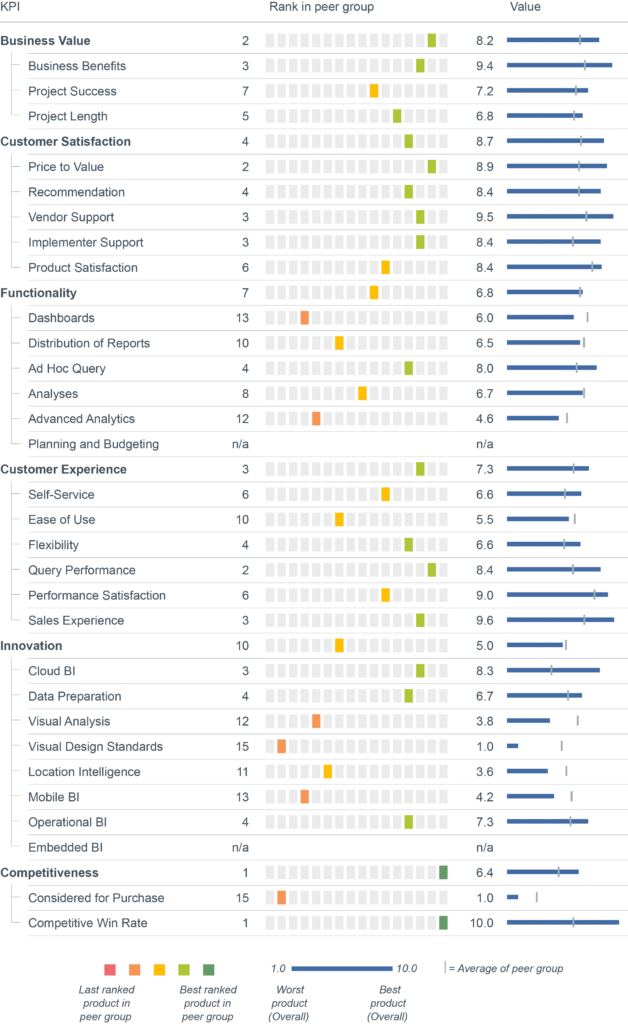
- Feedback in this year’s Financial Consolidation & Group Accounting Survey revealed a high level of customer satisfaction with the vendor’s and its implementers’ support services, sales experience, modeling flexibility, and user experience. The vast majority of customers say they would recommend the product to other organizations.
Challenges
- Cloud-only: The Anaplan platform, including Anaplan Integrated Financial Planning and Anaplan Financial Consolidation, is purely cloud-based and not available on premises. Web access is essential for using the products. When used in combination, data exchange between different cloud environments (AWS, GCP, and Azure) is required.
- Anaplan provides its own data integration options at various levels. Third-party ETL tools are also used to connect to source systems, especially when predefined data connections are required. Additionally, the platform’s capabilities can be extended using REST APIs, scripting, and transactional APIs. In this year’s survey, some customers indicated that predefined data connectivity and data integration capabilities have room for improvement. Anaplan’s new data orchestration platform, Anaplan Data Orchestrator (ADO), is rapidly maturing to address customer feedback, including adding source system specific APIs.
- Anaplan is a comprehensive planning, budgeting, forecasting, and consolidation platform, not a BI and analytics tool. However, it supports standard and ad hoc reporting through dashboards, management reports, Excel plug-ins, and personal pages. Additionally, prebuilt third-party analytics integrations with Tableau, Microsoft Power BI, and Qlik Sense connect Anaplan data and models to specialist tools. Anaplan XL Reporting (acquired with Fluence) will support users in reporting on Anaplan and non-Anaplan data sources via an Excel add-in, delivering this information in reports or dashboards (Excel, web, mobile).
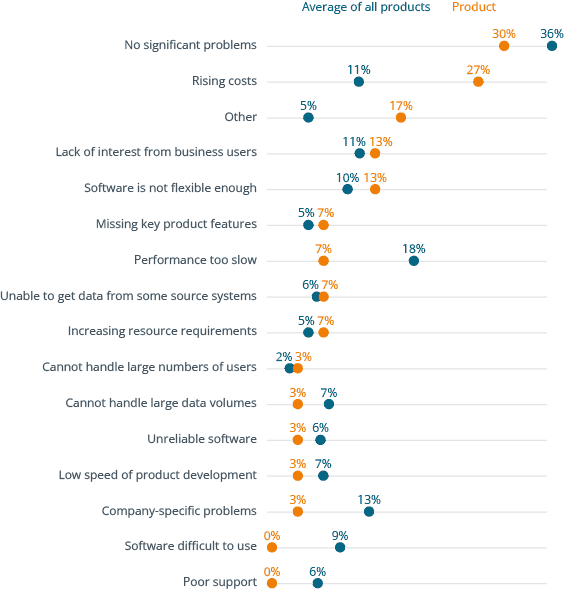
- According to customer feedback, 26 percent of survey respondents consider the product to be unreliable: a serious claim. Some users mentioned that the software malfunctioned after updates and that it is not secure enough.
Anaplan Financial Consolidation and Reporting (FCR) User Reviews & Experiences
The information contained in this section is based on user feedback and actual experience with Anaplan Financial Consolidation and Reporting (FCR).
The information and figures are largely drawn from BARC’s The BI & Analytics Survey, The Planning Survey, The Financial Consolidation Survey and The Data Management Survey. You can find out more about these surveys by clicking on the relevant links.
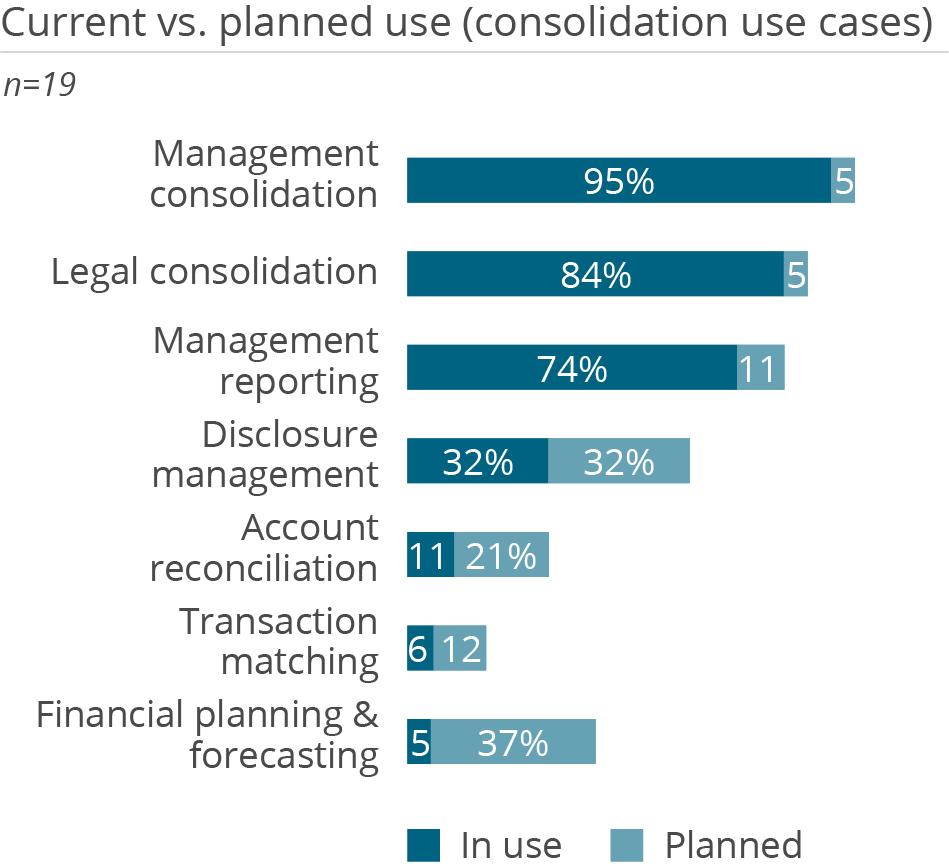
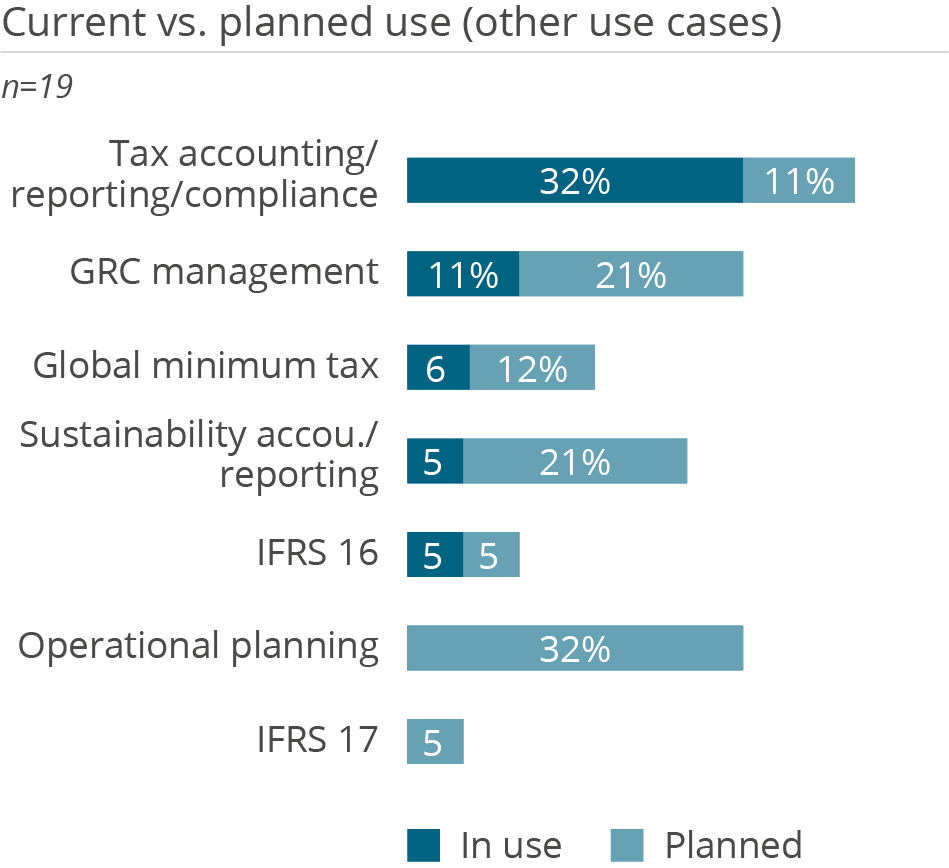
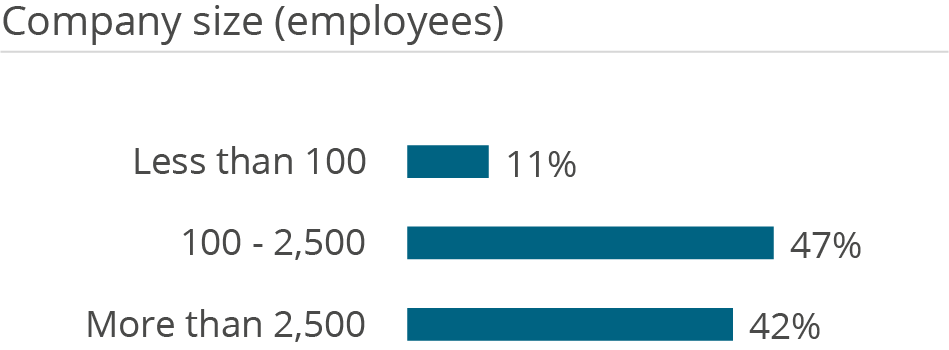
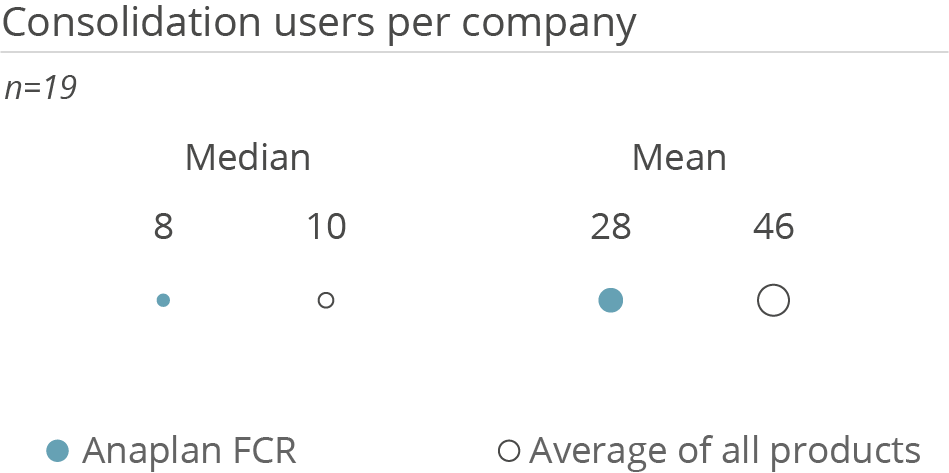
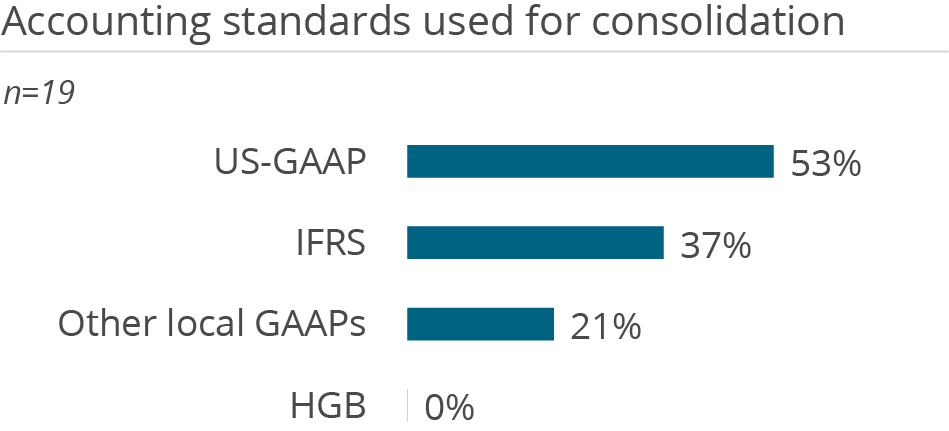
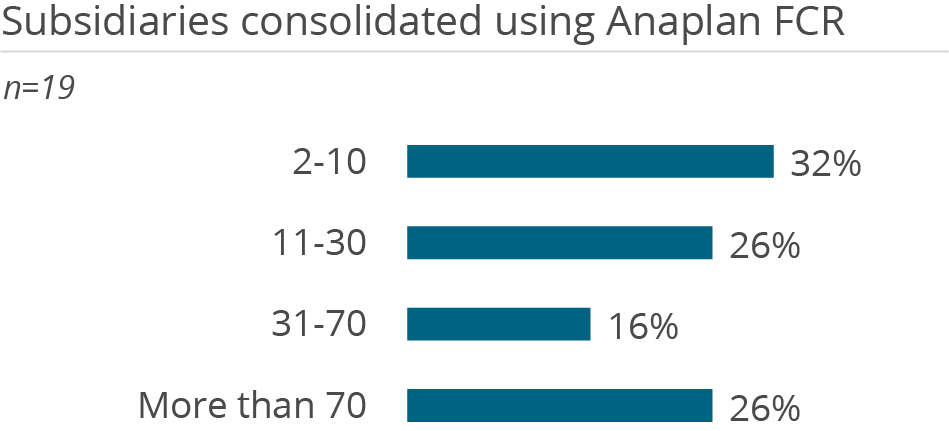
Who uses Anaplan Financial Consolidation and Reporting (FCR) in a financial consolidation context and how
Why users buy Anaplan Financial Consolidation and Reporting (FCR) and what problems they have using it

- Get independent information on software solutions, market developments and trends in data, analytics, business intelligence, data science and corporate performance management.
- Make data & analytics decisions based on numbers, data, facts and expert knowledge
- Access to all premium articles and all our research, including all software comparison studies, scores and surveys.
- Unlimited access to the BARC media library
- Consume unlimited content anywhere
Full user reviews and KPI results for Anaplan Financial Consolidation and Reporting (FCR)
All key figures for Anaplan Financial Consolidation and Reporting (FCR) at a glance.
- Get independent information on software solutions, market developments and trends in data, analytics, business intelligence, data science and corporate performance management.
- Make data & analytics decisions based on numbers, data, facts and expert knowledge
- Access to all premium articles and all our research, including all software comparison studies, scores and surveys.
- Unlimited access to the BARC media library
- Consume unlimited content anywhere
