For many years, organizations approached planning with the expectation that change would be incremental and largely predictable. Even disruptive events tended to follow familiar patterns that could be absorbed through annual budgets and periodic reforecasts.
Today, that assumption no longer applies. Business conditions are shaped by multiple, overlapping sources of uncertainty, from inflation and trade policy to geopolitical risk, supply chain disruption, and shifting demand. The environment is less linear and more dynamic, resembling a hockey game where the puck can change direction without warning. Unlike players on the ice, however, business leaders cannot simply react in real time. They must anticipate where the puck is headed, assess the implications of different trajectories, and prepare responses in advance—making scenario planning a critical capability for informed decision-making.
CFOs have a strategic responsibility to plan and forecast accurately, despite any number of unknown factors. In fact, in Resilient Planning in Volatile Markets, BARC found that 72% of companies confirm that geopolitical instability, market shocks, rising costs, and changing customer preferences have a disruptive influence on strategy and operations.
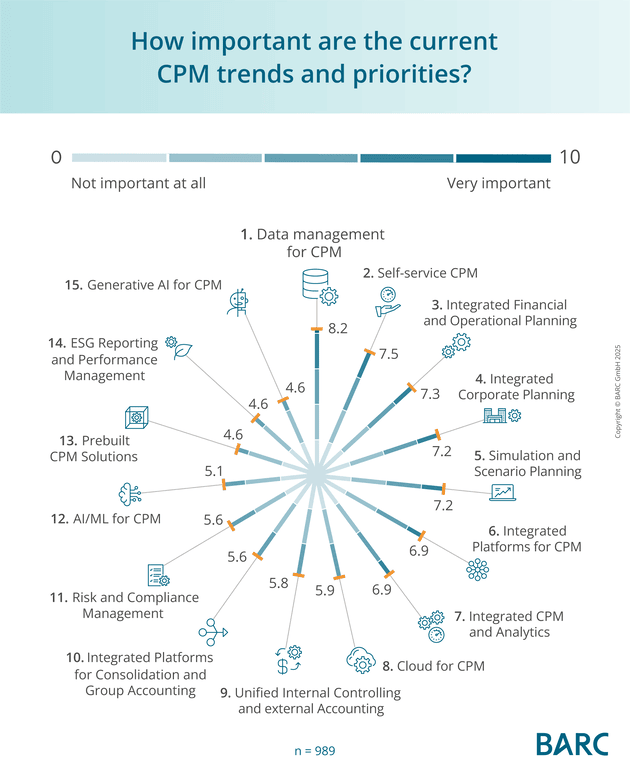
The good news is that many CFOs and organizations have embraced scenario planning and simulations, which rank among the top five corporate performance management (CPM) trends globally, as noted in the recentCPM Trend Monitor 2026 from Christian Fuchs of BARC and Craig Schiff of BPM Partners. It is seen as “indispensable for managing uncertainty.” According to the Trend Monitor, “Nearly every company surveyed is now incorporating scenario planning into its forecasting process.”
The value of scenario planning
In The Planning Survey 25, we highlight how simulations enable organizations to analyze and compare scenarios in a structured, evidence-based way. To be truly useful, scenarios need to include both upside and downside perspectives, supported by risk assessments, likelihood estimates, and potential response options. This level of scenario simulation has become a competitive differentiator, helping companies prepare for future developments, and better recognize emerging risks and opportunities.
Scenario planning and simulations facilitate and enable:
Agility by rapidly updating assumptions and plans
Preparedness by helping companies identify early warning signals
Confidence by grounding decisions in quantifiable potential outcomes rather than guesses
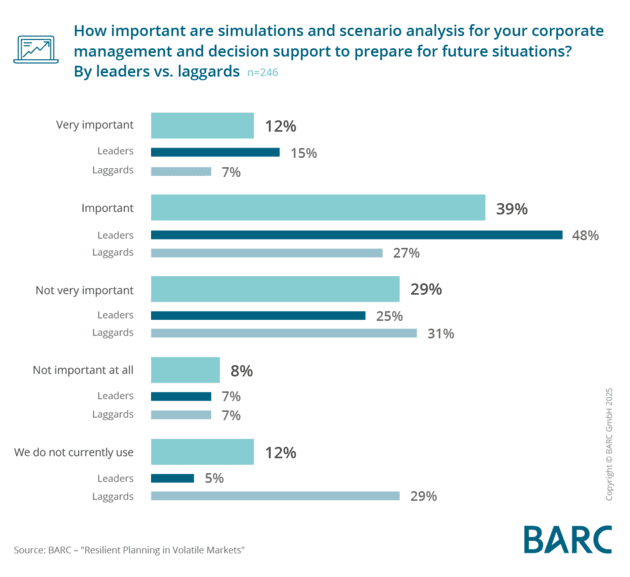
It appears that scenario planning is widely used. BARC research shows that 51% of companies surveyed regularly use simulations to navigate uncertainty. Digging a little deeper, our research also finds a discrepancy between leaders and laggards. In the Planning Survey, Leaders represent roughly the top 10% of companies based on business benefits achieved. Laggards make up approximately the bottom 10%.
Among leaders, 63% view scenario planning and simulations as essential. By contrast, 67% of laggards do not consider it essential. The majority of leaders understand the importance of forecasting with various assumptions. The majority of laggards do not see that as important. Simply put, those companies that outperform other companies understand the importance of scenario planning.
How AI is enhancing simulation and scenario planning
Yes, artificial intelligence (AI), and its related technology, machine learning (ML) is seemingly everywhere. This is becoming the case in CPM. Vendors in the market have embedded AI into their scenario planning solutions to simplify the process and improve results by generating more accurate probabilities from a broader range of data. More specifically, AI and ML are being used in predictive planning and forecasting and scenario comparisons. The next evolution will be the emerging role of agentic AI, with AI agents that autonomously test and adjust plans. AI enables faster delivery of data and insights, and better decision-making through deeper analytical insight into data.
But AI, or any technology for that matter, does not prescribe to the “Field of Dreams” approach of ‘build it and they will come,’ (yes, this is paraphrased—the actual quote is “If you build it, he will come”). Just because vendors are adding AI everywhere, will end users really use these features? It appears so. BARC research finds that 40% of survey respondents plan to use predictive forecasting and AI-supported planning to “provide valuable insights, improve efficiency, and enhance accuracy through automated predictions.” In fact, 44% expect to use AI for creating scenarios more quickly.
What are leaders doing with scenario planning?
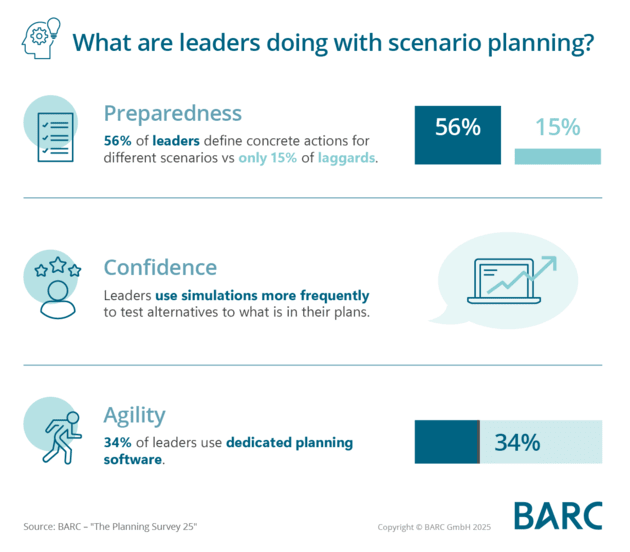
Given the importance leaders place on scenario planning, it’s logical to conclude that their use of scenario planning is widespread and sophisticated. Three data points emerge:
Preparedness, by using scenario-based triggers tied to key performance indicators (KPIs) and defining concrete actions for different scenarios (56% of leaders vs. 15% of laggards)
Confidence, by using simulations more frequently to test alternatives to planned assumptions
Agility, with 34% of leaders using dedicated planning software
Scenario planning enables companies to skate to where…
Here’s where I add in the famous Wayne Gretzky quote. It’s one I use often. Except, it turns out the quote was originally from his father, Walter Gretzky: “I skate to where the puck is going to be, not where it has been.”
An ice hockey game is inherently fast-moving and volatile. But as unpredictable as the ice can be, today’s business environment is far more complex. Market shocks, geopolitical shifts, inflation and changing customer behavior mean the puck is now moving in multiple directions at once. And its speed is accelerating.
Scenario planning gives companies the ability to not just react, but also to anticipate. It gives them a path to skate to where the puck might end up.
Navigating economic volatility while pressured to improve efficiency and decision quality?
See the strategic priorities of 989 finance leaders. The CPM Trend Monitor 2026 reveals what best-in-class companies are doing to improve decision quality right now.
Kelley Lynn Kassa is a seasoned marketing executive specializing in Corporate Performance Management, with more than 20 years of experience in marketing and communications in software and advisory services. She has held key roles at Applix, IBM, Varicent, and Datawatch, and BPM Partners, and for the past 13 years has provided marketing thought leadership content and programs for Revelwood—an implementation partner for IBM Planning Analytics, Workday Adaptive Planning, BlackLine, and Incorta.
An accomplished writer, Kelley has contributed to MIT Sloan Executive Education’s Innovation at Work blog, Foodies of New England magazine, and a wide range of clients over the years. She is recognized for her ability to translate technical detail into big-picture stories and turn complex data into clear, actionable insights.
Beyond her professional work, Kelley has held volunteer leadership roles with several community organizations, including the Irish Immigration Center and the Charitable Irish Society. She is also an active rower, coxswain, and coach at Community Rowing, Inc.
Our newsletter is your source for the latest developments in data, analytics, and AI!