


As more teams try to scale data and AI use cases beyond pilots, a common gap appears between skills and reality. You can hire big consultancies to teach your employees Python. They’ll come, they’ll charge a premium, and your people will learn Python. What they won’t learn is where your data lives, how it flows through your infrastructure, or what your governance framework allows them to do with it. They’ll have the skill, but not the context.
So the real question isn’t “Can they learn Python?” It’s “Can they apply it in your environment?”
Dr. Boris Adryan, Director of Merck’s Data & AI Academy, has spent three years showing what context-first upskilling looks like in practice. At Merck, it takes the form of a ten-week internal program. It is taught entirely by Merck’s own practitioners and turns business professionals into citizen data scientists.
What is a citizen data scientist?
A business professional who can formulate data questions, run analyses and build simple models on their own, but stays in their business role. At Merck, the “citizen” prefix distinguishes program graduates from formally trained data scientists.
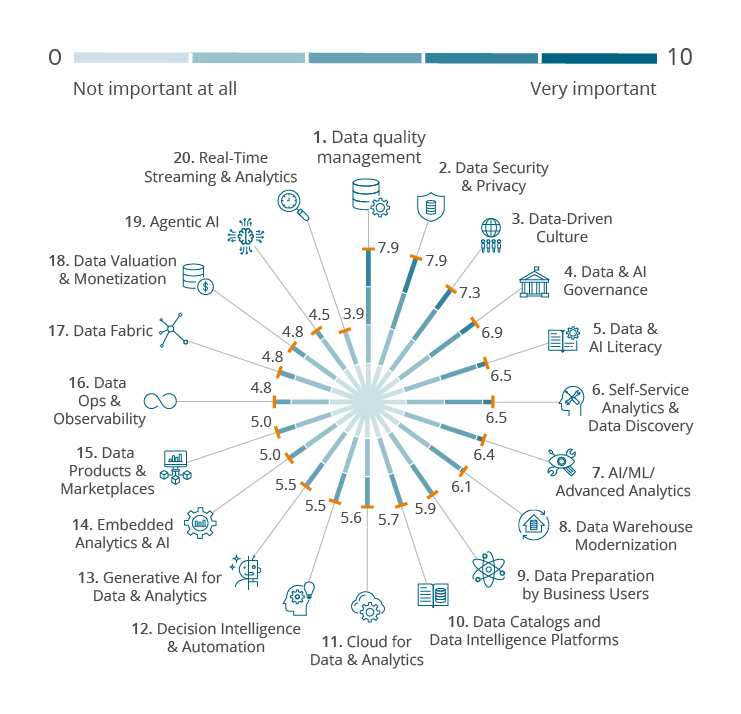
The data backs him up. The BARC Trend Monitor 2026, based on responses from nearly 1,600 professionals, ranks “establishing a data-driven culture” as one of the toppriorities for the fifth consecutive year, consistently ahead of hype topics such as generative AI and agentic AI. Best-in-class companies rate its importance 8.4 out of 10, compared to 7.1 among laggards. Programs like Adryan’s show what that gap looks like in practice.
From zero to citizen data scientist in ten weeks
Adryan’s target is ambitious: at least 20% of Merck’s roughly 63,000 employees should be able to work with data. Not as data scientists, but as professionals who can formulate a data question, assess data quality and make evidence-based decisions.
To get there, Merck built a modular curriculum in three stages:
- Foundations (week 1): Open to anyone. The focus is on ideation and mindset: What data do you have? Is it structured? What quality issues exists? Can you formulate a business question around it? From these questions, participants develop a use case that carries through the entire program.
- Analyst track (week 2-4): For those who show aptitude, interest and manager support. Two weeks of learning to read and understand Python and SQL, followed by a one-week hackathon where participants implement their use case with a dedicated mentor from a data function.
- Citizen data scientist track (week 5-10): Inferential statistics and machine learning with a hands-on project phase. The end result: an implemented use case.
Since 2022, Adryan has brought a total of 500 to 600 employees through the first stage, with around 300 participants per year. About 10% progress to the analyst course, and around 20 per year complete the full citizen data scientist track. 300 in, 20 out. A deliberate funnel.
What makes internal training different
Practitioners teach practitioners. Mentors come from the same business functions as participants, reducing what Adryan called “friction loss due to language.” An R&D data scientist mentors an R&D employee. A commercial analyst coaches someone from controlling.
“I would tell people they can get the same knowledge by sitting in 20 weeks of e-learning, and nobody would take that course.” — Boris Adryan
Training at international locations. Part of the program takes place at attractive international locations, such as São Paulo or Bangalore. The workload is significant, but Adryan turns each cohort into an event: catering, evening activities, wining and dining included. The informal conversations at dinner teach vocabulary, tricks and perspectives that no structured module could deliver.
The hype is intentional. Seats are limited, demand exceeds supply, and the locations create stories that spread through the organization. The result: a program people compete to join, not one they’re forced to attend.
How do you prove the ROI to your CFO?
Numbers talk. Most projects completed during the upskilling program generate little tangible return, what Adryan calls “pocket money.” But around 20% of use cases deliver value in excess of €100,000 or more, generated by people whose primary tool had been Excel.
The hiring math adds up too. Merck estimates that recruiting an external data scientist costs roughly €100,000 in process costs alone. About a quarter of those who complete the full program eventually move into data analytics roles. “You have someone who trained as a chemical engineer or as an accountant and now knows how to analyze data,” Adryan said. “Probably not a superstar, but good enough to solve problems. And a lot cheaper.”
What does this mean for your data culture strategy?
Here’s what stayed with me after Adryan’s session.
- Generic e-learning can supplement, but it can’t replace practitioners who know your data, your tools and your governance framework. If you want people to work with data, have the people who already work with data teach them.
- Not everyone needs to become a citizen data scientist. Merck’s funnel, 300 entrants down to 20 specialists per year, makes that clear. The point is not the 20 at the end. It’s the 300 who now understand what a data question looks like.
- Adryan didn’t start expecting a financial return. But by tracking project outcomes, he built an evidence base that keeps executive support alive year after year. If your CFO asks what the program is worth, you need an answer. Adryan has one. And it turns the budget conversation from “What does this cost?” into “What capability are we building?”